Penalising 'Hard Work, Thrift and Enterprise'!
Stephen Byers is worried that inheritance tax is 'penalising hard work, thrift and enterprise'
‘The rich shall inherit the earth. It is easier for a rich man to pass through the eye of the needle than it is to find a camel in Swindon.’ Not quite a quote from the Bible
With so many Christian amongst the ranks of the Blairites you would imagine they would remember their Bible. Wasn’t it ‘the meek shall inherit the earth’? It is ‘easier for a camel to pass through the eye of a needle than a rich man to pass into heaven’. Apparently not. You may remember that ex-minister Stephen Byers was the man who famously leaked the idea of Labour breaking the link with the unions. Labour must be a party of the nation rather than 'the party of the working class'. Now he has drawn attention to the terrible plight of ‘successful’ people who suffer the indignity of having to pay inheritance tax. With so many ‘aspirant’ people having benefited from 9 years of a New Labour government they are, says Byers, being unfairly taxed given the increase in the value of houses. It is “a penalty on hard work, thrift and enterprise”.
In fact house prices are not the result of ‘success’. Home owners have had to do nothing but watch the value of their houses rise. This is an example of making a fortune without doing a thing. One of the factors fuelling this phenomenon was the decision of the Thatcher government to stop building council houses and to give tenants ‘the right to buy’. This helped to create the housing shortage which has fuelled the massive increase in house prices.
Inheritance tax is one of the last remaining features of the progressive taxation system which existed in the post second world war years, until Thatcher came to power. It used to be a social obligation to pay more tax the richer you were. But New Labour long ago abandoned progressive taxation and reintroduced means testing which not only demeans people, but wastes resources since it is very expensive to collect.
Byers bid to reorient New Labour to win back middle England appears to have been rejected by the Treasury (aka Gordon Brown) though only on the pragmatic grounds that this would leave a £3.3 billion hole in the public purse.
Rather than being the boon that New Labour believes it to be, home ownership for many people was not a choice, but a necessity, especially given the huge increase in Council House waiting lists. Home ownership for many is a terrible burden which means that people have to work long hours in order to scrape by, struggling to manage their finances from month to month. Mortgages used to be given to people on the yardstick of two and a half times their wages. Today, it is not uncommon for a mortgage to be measures on the scale of five or more times a person’s wages.
A couple of years ago, a Labour councillor in Swindon complained that there were some people living on my council estate who were the third generation to do so. This apparently showed their lack of ‘poverty of ambition’. It never occurred to him that people like living there. Home ownership is part of the rat-race in which collective interests are abandoned for personal salvation.
There is nothing natural about wanting to be a house owner as opposed to renting. Indeed a recent survey by Shelter showed that a large majority of people in need of housing wanted a decent, affordable home, whilst ownership was well down the list of priorities.
Monday, August 28, 2006


Friday, July 28, 2006
John McDonnell Campaign
Left wing Labour MP John McDonnell has declared he will stand against Gordon Brown for Labour leader when Blair departs. You would imagine that given his record of campaigning for the trades unions and opposing the whole Blairite agenda that the affiliated unions would obiously support John McDonnell’s. Can they really support Brown who is driving the government’s neo-liberal agenda, privatising public services and destroying public sector jobs?The experience of 9 years of a right wing Blair government has driven vast numbers of members out of the Labour Party. So much so that most local parties are empty shells. Having promised to create a party of one million members Blair has merely succeeded in halving the membership. Many socialists will view the question of who takes over from Blair with indifference, not least because either Brown or any candidate supported by Blair’s clique will continue with the neo-liberal ‘free market’ programme of the current government.
John is appealing to people to return to the party to take part in the campaign. It remains to be seen how many do, but it will probably not be that many since nobody believes that he stands a chance of getting anywhere near winning. However, it would be a mistake if socialists in the affiliated unions took the view that the change of leadership is of no consequence. So long as the unions remain affiliated to Labour then we should demand that instead of collaborating with the Blair/Brown leadership they should argue for a fundamental change of political direction. To support Brown (as ‘the only serious candidate’) or to sit on their hands and passively await his ‘coronation’ would be a grave disservice to union members who are daily being attacked by this government.
The affiliated unions should oppose any attempt to rig a ‘smooth transition’ from Blair to Brown. In the first instance they should insist on a democratic process in which a discussion takes place on policy questions. Secondly, if any of the trade union critics of the government accept a ‘coronation’ of Brown then union members could only draw the conclusion that their criticism of government policy was mere hot air. Brown was one of the authors of PFI and is the main driver of privatisation throughout the public sector.
John McDonnell’s campaign for the leadership of the Labour Party should be seen as a welcome (if somewhat belated) challenge against the whole political programme of ‘Blairism’. One does not have to be a Labour Party member to support the campaign. Any member of an affiliated union has the right to demand that their union declare its support for McDonnell. We should not watch with disinterest if the union leaders line up behind Brown.
Writing on the Labour Representation Committee conference which agreed to support his candidature John McDonnell talked of the choice which should be presented to party members in the leadership election:
• between promoting public services or continued privatisation.
• between free education or trust schools and tuition fees.
• between increasing the state pension and restoring the link with earnings or forcing more people onto the means test.
• between allowing councils to build council houses once again or high rents, escalating housing costs, homelessness and overcrowding.
• between energy from green power sources, conservation, and British clean coal or the costs and risks of nuclear power.
• between promoting civil liberties and trade union rights or reactionary incursions into the right of free speech, assembly and trial.
• between a government committed to peace, withdrawal from Iraq and nuclear disarmament or backing Bush's wars and wasting £24 billion on Trident.
With the exception of the question of nuclear power the unions are fundamentally in conflict with this government’s policy. What sense would it make to support a candidate who would continue with the policies which the unions are opposed to and for which their members are paying a heavy price? Campaigning for the affiliated unions to support McDonnell is necessary to challenge the conciliators of New Labour at the top of the unions, who have given the Blair government an easy ride.
The latest example of union leaders facing both ways – criticising the policy of the government but acting as if they were friends of the working class – was the GMB Congress. The Congress took some positive decisions, including breaking with the ‘partnership’ agenda so beloved on New Labour. Yet when Blair spoke he was given a standing ovation by many delegates, whilst the top table uttered kind words about this reactionary ‘free market’ fanatic whose government is privatising across the public sector and supporting a right wing Republican President in the international arena. You cannot stand up for union members and stand up for Blair.
Many union leaders will no doubt say that John McDonnell is not a ‘serious candidate’. If they can find a more serious one then let them. But this is not the basis of their relectance to support him. They do not want to oppose the leadership of New Labour. Do they seriously believe that their powers of persuasion can miraculously transform New Labour into a union friendly party? This is self-delusion. Even Brendan Barber has said that a ‘fundamental change of direction’ from New Labour’s agenda is necessary. Pretending that the New Labour leaders are our friends is at complete variance with nine years experience. Year after year the unions have won policy at Labour’s conference, defeating the privatisation agenda. But, of course, the government has simply ignored those votes. Good arguments will not convince people who are ideologically committed to privatisation that they must abandon the entire rationale of their policy.
Perhaps the calculation of some union leaders is that if they support a candidate against Brown this will burn bridges with him and mean they have no ‘influence’ with him. Such ‘influence’ is nothing more than self-delusion. The government has given away a few crumbs, but it’s overall political direction is fundamentally opposed to the interests of union members and the working class in general. Union leaders may see such an approach as ‘realism’. In reality it is the worst opportunism.
It is the collaboration with the government which the union leaders have for the most part carried out, which has allowed it to get away with a programme of abandonment of the welfare state, privatisation of public services, and support for a right wing republican administration in the USA on the international level.
In return for the Warwick Agreement the major union leaders have effectively agreed to restrain their members in order not to ‘risk’ the prospects of a fourth term for Labour. That has meant compromise in the pension dispute, abandoning the new generation of workers who will be on worse terms and conditions of service than existing staff, and failing miserably to develop any serious campaign against the government’s fracturing of the NHS and opening up of it to big business.
Writing on his blog CWU leader Billy Hayes wrote:
“Problems of disengagement from Labour are linked to the Government’s support for Bush’s foreign policy, and the neo-liberal attacks on the welfare state. Change the policies and make our Party worth joining again.”
Billy has been one of the most vociferous proponents of the ‘stay in and fight’ line amongst the trade union leaders. It will be interesting to see, especially since the CWU is affiliated to the Labour Representation Committee, whether he seeks to win the CWU to supporting John McDonnell’s campaign. So far he has remained silent. But all of the union leaders are being put to the test now because the camapign for the leadership of the party puts them on the spot.
Of course, the campaign has a very difficult job on its hands for it has to win the support of 44 Labour MPs in order for John to become a candidate. It is questionable as to whether such a large number can be pressured to openly support a campaign for a break with the political direction of New Labour. If it fails to get John on the ballot then even those such as Labour Briefing, which hangs doggedly to work in the Labour Party, may well draw the conclusion they have resisted to draw for so long, the need to build a socialist alternative to New Labour. That is the expressed view of Graham Bash, one of its leading lights.
“If there were simply a coronation of Brown - without even an attempt to mount a left challenge - this would be yet another nail, possibly a final nail, in the coffin of not only the Labour left, but also the Labour Party as a class party. John’s brave attempt to raise the banner of core Labour and socialist values is either the beginning of the fightback or, if it makes little impact, the beginning of the end for the Labour Party itself.”
Whatever the outcome, socialists in the affiliated unions should not allow their union leaders to talk out of both sides of their mouths, criticising the government but failing to seriously organise a struggle against it.
Supporting John McDonnell’s campaign does not mean agreeing with the perspective of ‘winning back Labour’, it simply means that we do not allow the union leaders to go unchallenged should they propose to support Brown or some other creature of the Blairites. If they support the line of ‘staying in and fighting’ let them show us they are serious about fighting the government. If they were serious about overturning the politics of Blair they would have organised a candidate themselves. As it is John McDonnell offers the only chance within the Labour Party of challenging the political agenda for which our members are paying such a high cost. Brown is as much as enemy of the labour movement as Blair is.
http://www.john4leader.org.uk
Left wing Labour MP John McDonnell has declared he will stand against Gordon Brown for Labour leader when Blair departs. You would imagine that given his record of campaigning for the trades unions and opposing the whole Blairite agenda that the affiliated unions would obiously support John McDonnell’s. Can they really support Brown who is driving the government’s neo-liberal agenda, privatising public services and destroying public sector jobs?The experience of 9 years of a right wing Blair government has driven vast numbers of members out of the Labour Party. So much so that most local parties are empty shells. Having promised to create a party of one million members Blair has merely succeeded in halving the membership. Many socialists will view the question of who takes over from Blair with indifference, not least because either Brown or any candidate supported by Blair’s clique will continue with the neo-liberal ‘free market’ programme of the current government.
John is appealing to people to return to the party to take part in the campaign. It remains to be seen how many do, but it will probably not be that many since nobody believes that he stands a chance of getting anywhere near winning. However, it would be a mistake if socialists in the affiliated unions took the view that the change of leadership is of no consequence. So long as the unions remain affiliated to Labour then we should demand that instead of collaborating with the Blair/Brown leadership they should argue for a fundamental change of political direction. To support Brown (as ‘the only serious candidate’) or to sit on their hands and passively await his ‘coronation’ would be a grave disservice to union members who are daily being attacked by this government.
The affiliated unions should oppose any attempt to rig a ‘smooth transition’ from Blair to Brown. In the first instance they should insist on a democratic process in which a discussion takes place on policy questions. Secondly, if any of the trade union critics of the government accept a ‘coronation’ of Brown then union members could only draw the conclusion that their criticism of government policy was mere hot air. Brown was one of the authors of PFI and is the main driver of privatisation throughout the public sector.
John McDonnell’s campaign for the leadership of the Labour Party should be seen as a welcome (if somewhat belated) challenge against the whole political programme of ‘Blairism’. One does not have to be a Labour Party member to support the campaign. Any member of an affiliated union has the right to demand that their union declare its support for McDonnell. We should not watch with disinterest if the union leaders line up behind Brown.
Writing on the Labour Representation Committee conference which agreed to support his candidature John McDonnell talked of the choice which should be presented to party members in the leadership election:
• between promoting public services or continued privatisation.
• between free education or trust schools and tuition fees.
• between increasing the state pension and restoring the link with earnings or forcing more people onto the means test.
• between allowing councils to build council houses once again or high rents, escalating housing costs, homelessness and overcrowding.
• between energy from green power sources, conservation, and British clean coal or the costs and risks of nuclear power.
• between promoting civil liberties and trade union rights or reactionary incursions into the right of free speech, assembly and trial.
• between a government committed to peace, withdrawal from Iraq and nuclear disarmament or backing Bush's wars and wasting £24 billion on Trident.
With the exception of the question of nuclear power the unions are fundamentally in conflict with this government’s policy. What sense would it make to support a candidate who would continue with the policies which the unions are opposed to and for which their members are paying a heavy price? Campaigning for the affiliated unions to support McDonnell is necessary to challenge the conciliators of New Labour at the top of the unions, who have given the Blair government an easy ride.
The latest example of union leaders facing both ways – criticising the policy of the government but acting as if they were friends of the working class – was the GMB Congress. The Congress took some positive decisions, including breaking with the ‘partnership’ agenda so beloved on New Labour. Yet when Blair spoke he was given a standing ovation by many delegates, whilst the top table uttered kind words about this reactionary ‘free market’ fanatic whose government is privatising across the public sector and supporting a right wing Republican President in the international arena. You cannot stand up for union members and stand up for Blair.
Many union leaders will no doubt say that John McDonnell is not a ‘serious candidate’. If they can find a more serious one then let them. But this is not the basis of their relectance to support him. They do not want to oppose the leadership of New Labour. Do they seriously believe that their powers of persuasion can miraculously transform New Labour into a union friendly party? This is self-delusion. Even Brendan Barber has said that a ‘fundamental change of direction’ from New Labour’s agenda is necessary. Pretending that the New Labour leaders are our friends is at complete variance with nine years experience. Year after year the unions have won policy at Labour’s conference, defeating the privatisation agenda. But, of course, the government has simply ignored those votes. Good arguments will not convince people who are ideologically committed to privatisation that they must abandon the entire rationale of their policy.
Perhaps the calculation of some union leaders is that if they support a candidate against Brown this will burn bridges with him and mean they have no ‘influence’ with him. Such ‘influence’ is nothing more than self-delusion. The government has given away a few crumbs, but it’s overall political direction is fundamentally opposed to the interests of union members and the working class in general. Union leaders may see such an approach as ‘realism’. In reality it is the worst opportunism.
It is the collaboration with the government which the union leaders have for the most part carried out, which has allowed it to get away with a programme of abandonment of the welfare state, privatisation of public services, and support for a right wing republican administration in the USA on the international level.
In return for the Warwick Agreement the major union leaders have effectively agreed to restrain their members in order not to ‘risk’ the prospects of a fourth term for Labour. That has meant compromise in the pension dispute, abandoning the new generation of workers who will be on worse terms and conditions of service than existing staff, and failing miserably to develop any serious campaign against the government’s fracturing of the NHS and opening up of it to big business.
Writing on his blog CWU leader Billy Hayes wrote:
“Problems of disengagement from Labour are linked to the Government’s support for Bush’s foreign policy, and the neo-liberal attacks on the welfare state. Change the policies and make our Party worth joining again.”
Billy has been one of the most vociferous proponents of the ‘stay in and fight’ line amongst the trade union leaders. It will be interesting to see, especially since the CWU is affiliated to the Labour Representation Committee, whether he seeks to win the CWU to supporting John McDonnell’s campaign. So far he has remained silent. But all of the union leaders are being put to the test now because the camapign for the leadership of the party puts them on the spot.
Of course, the campaign has a very difficult job on its hands for it has to win the support of 44 Labour MPs in order for John to become a candidate. It is questionable as to whether such a large number can be pressured to openly support a campaign for a break with the political direction of New Labour. If it fails to get John on the ballot then even those such as Labour Briefing, which hangs doggedly to work in the Labour Party, may well draw the conclusion they have resisted to draw for so long, the need to build a socialist alternative to New Labour. That is the expressed view of Graham Bash, one of its leading lights.
“If there were simply a coronation of Brown - without even an attempt to mount a left challenge - this would be yet another nail, possibly a final nail, in the coffin of not only the Labour left, but also the Labour Party as a class party. John’s brave attempt to raise the banner of core Labour and socialist values is either the beginning of the fightback or, if it makes little impact, the beginning of the end for the Labour Party itself.”
Whatever the outcome, socialists in the affiliated unions should not allow their union leaders to talk out of both sides of their mouths, criticising the government but failing to seriously organise a struggle against it.
Supporting John McDonnell’s campaign does not mean agreeing with the perspective of ‘winning back Labour’, it simply means that we do not allow the union leaders to go unchallenged should they propose to support Brown or some other creature of the Blairites. If they support the line of ‘staying in and fighting’ let them show us they are serious about fighting the government. If they were serious about overturning the politics of Blair they would have organised a candidate themselves. As it is John McDonnell offers the only chance within the Labour Party of challenging the political agenda for which our members are paying such a high cost. Brown is as much as enemy of the labour movement as Blair is.
http://www.john4leader.org.uk
Tuesday, June 20, 2006
Michael Wills is worried…
North Swindon MP Michael Wills is worried. His speech to a fringe meeting at the conference of new Labour pressure group Compass, was reported on the front page of the Guardian in the lead article. Mr Wills is known to have a close friend by the name of Gordon. Perhaps this explains the prominence of his comments. At any rate he is warning of the prospect of electoral defeat at the next General Election. Whilst he recognises "profound disillusion and disnegagement" amongst Labour supports he fails to face up to the roots of this.
North Swindon MP Michael Wills’ is worried, and you can understand why. Speaking at a fringe meeting at a conference organised by the new Labour pressure group, Compass, he claimed that at the General Election “every single Labour MP on the doorstep reported profound disillusionment and disengagement”. This does have the merit of trying to grapple with reality, whilst the Prime Minister and his coterie merely seem to want deny that such a thing exists. But when it comes to an appreciation of the roots of this “profound disillusionment” of traditional Labour voters, Wills cannot himself face the reality. The problem it seems is that the voters will not listen to New Labour’s “message”. It is they who are at fault not New Labour!
“Unless we can get people to start listening to us, unless they are prepared to hear the message we are putting across, we are going to lose next time. There is no question of that.”
There are none so blind as cannot see. There are none so deaf as those who refuse to listen! Wills is suggesting that the problem is one of presentation rather than substance. The electors refuse to see the reality of New Labour’s ‘successes’. How very irrational of them. What Michael Wills and New Labour cannot face up to is the fact that it is what the government is doing which has alienated vast swathes of its traditional supporters; and not just the Iraq war which he says lost him 3,500 votes. It is very common to hear the refrain from people who have voted Labour for many years, ‘they are no different to the Tories’. Whilst there are differences with the Tories Blair reconstructed the Party on the same ground as Thatcherism. This involved the abandonment of the welfare state, not its ‘modernisation’, and the progressive marketisation of public services. They have even introduced a market into the NHS in which hospitals have to ‘compete’ for patients. In Wiltshire this has led to an unprecedented crisis, with the decimation of services (see http://martinwicks.blogspot.com/2006/05/health-crisis-what-crisis-health.html ).
Wills is right when he says that the electorate does not ‘trust us’. And he recognises that the ‘Presidential style’ of the Prime Minister is a problem. But he cannot face up to the fact that it is the substance of New Labour which is the reason for the disillusionment of its traditional supporters and the decline of its membership.
Wills is worried about losing his Parliamentary seat, of course. The crisis of New Labour in Swindon does not bode well for his chances. The Council, which was historically a Labour one for decades has seen a precipitous decline both in the Party’s organisation and in the number of councillors. Even in the Thatcher days the Tories did not gain control, even though they had the MP. Yet after 3 years of the Blair government Labour lost its majority on the Council, though remaining the largest party. In 2000 it had 28 councillors to 24 Tories. Today the Tories have 42 and Labour has only 12. Four Labour Councillors have defected to the Tories, one resigned and left local politics, and one broke with Labour over their support for increasing Councillors’ allowances at the same time as the Tories were cutting services.
The dilemma of New Labour in Swindon was in part summed up by an article in the Swindon Advertiser by Michael Wills and South Swindon’s ultra-New Labourite MP, Anne Snelgrove, on the future of the town. What criticism did they make of the Tory Council? That they are privatising council departments? That they are not opposing Bath University’s ultimatum on the location on which it wants to build a campus?1 That they are accepting vast numbers of new houses being imposed by an unelected body in the South West? That they are trying to rush through a proposal for an Academy which will be run by a private company? Alas, our two MPs accept all this, just as the Tories do.
Well might Private Eye ridicule Anne Snelgrove for her comment that ‘the country’ is ‘proud’ of the work of the Deputy Prime Minister.2 This is the man who has the Midas touch in reverse. He turns gold to dross. This is the man who has given power over our town (and others) to an unelected body which, at his department’s prompting tells us how many houses we ‘need’, regardless of our view. This is the man who has made the planning process less democratic. This is the man who has sought to eradicate Council Housing and still maintains the effective ban on Councils building new houses. The reality is that Prescott is the object of ridicule and contempt in equal measure, astutely summed up by Steve Bell’s cartoon, the bulldog caricature.3
So what are the profound differences with the Tories which the MP’s revealed in their article? Apparently the Tories are not “sufficiently ambitious” for the town. Instead of, dare we say, a bog-standard library, “why not plan for one that surpasses the best elsewhere”. Frankly, this is pathetic, providing an easy target for the Tories, who can say with some legitimacy, why didn’t Labour produce a new library in all the years they were in power? 4
We have also seen the spectacle of the MP’s complaining that the Tory Council does not build enough social housing. This is the cheek of Old Nick after 9 years of a New Labour government. One Labour Councillor informs me that he told Michael Wills, “it’s your government which is stopping Council house building”. As for Anne Snelgrove, as we discovered at the Defend Council Housing lobby of Parliament, she is opposed to Councils building their own houses. (See http://martinwicks.blogspot.com/2006/02/home-owning-democracy-whats-in-phrase.html )
Undoubtedly the decline in Labour’s support in Swindon reflects the national picture of disaffection amongst traditional labour supporters. But when a Labour candidate in Parks (a council estate where I live) manages barely a 100 majority over a Tory candidate you know the party is in trouble.
In the old days (certainly pre-Blair) political and ideological differences between the two major parties were significant enough to make defection from one to the other very rare. But that was before Blair’s political and ideological coup. That four councillors have crossed over to the Tories reflects the absence of real ideological differences.5 The recent defector Mavis Childs said that she wanted to get things done for her constituents. Their interests “come before party politics”, she says. Clearly, according to this logic, the only place to have a direct influence is in the ruling Tory group which has an absolute majority.
What New Labour in Swindon has yet to explain is why the Tories have gained such a big majority; why it has declined so precipitously. Amidst all the hype in the early Blair days we were told that the party was going to increase its membership to 1 million. In fact, so disgusted has much of the membership been with Blair that instead of an influx he has succeeded in more than halving the party membership. Perhaps our MPs can explain why, if the government has been such a ‘success’, party membership is less than half the 1997 level. We wait with baited breath. Perhaps the members failed to face up to reality just like the electorate.
Why should traditional Labour voters, never mind anybody else, vote for New Labour? This is the question posed as a result of 9 years of a ‘business friendly’, privatising government. What is the difference between what a Labour Council would do in office and what the Tory Council is doing now? Unless the electorate sees some positive reason to vote Labour again, then the Tories will maintain their stranglehold on the Council, at the expense of working class people. The Tories appear to be ‘getting things done’. If the policy of New Labour hardly differs from that of the Tories, then why not vote for the more effective or ‘efficient’ party? Such at least was the conclusion of Mavis Childs.
Labour can hang on and wait for the electorate to get fed up with the Tories, but overturning such a big majority could take a long time. If they want to campaign against them in a way which resonates with local people, and is believable, they have to have a different programme and policy. But here they face the twin obstacle of their government and their MPs, both of whom are New Labour zealots.
Labour could have allies to build opposition to the Tory Council. For instance, they could work with the local government unions to oppose the Tories privatising Council departments. Unfortunately, there is no sign as yet of them opposing the Tory policy.
Labour could campaign with the unions and tenants for the right of Councils to build Council housing once again. Two Labour councillors joined the delegation which lobbied Parliament in relation to the ‘fourth option’. The housing crisis facing the town is a major issue. House prices in Swindon are too high for many local people. All we see being built in the town centre at the moment are luxury flats. The Council house waiting list will not be cut without a Council house building programme. A campaign to change government policy, to allow Councils the right to build new Council housing would be a significant difference with the Tory Council.
Labour could campaign for the Housing benefit and Council Tax service to be brought back in-house. OK, it was they who privatised it, handing it over to WS Atkins with disastrous consequences.6 However, they could recognise it as a mistake and campaign for the service to be brought back in-house. Thus far the Party has missed the opportunity of criticising the Tory administration over its latest move in relation to Liberata (the company which took over from WS Atkins). These worshippers of ‘the market’ (the Tory Council in this case) have punished Liberata for failing to carry out their contract with the Council, by handing over to them an extra £850,000! You might imagine that if the company fails to carry out their contractual obligations to a satisfactory standard then they would take the financial hit rather than the Council Tax payers of Swindon, especially at a time when the Council was cutting services. Isn’t this supposed to be the ‘free market’? But even here New Labour has failed to attack the Tories for feather-bedding a private company with our money. What better opportunity than this to demand the service be brought back in-house?
Labour could campaign with the trades unions and local people against the Academy which is proposed to replace Headlands school. That would mean opposing government policy, of course. Yet Michael Wills was over the moon at the involvement of Honda in the proposed project. Labour movement people on the other hand are appalled at the involvement of an anti-union car firm in Education.
The Labour group could attack the Tory Council for its fraudulent ‘consultation’ on the issue. Lead member Garry Perkins has said that this is the only way that the people of the area will get a new school, so there is no debate about whether or not local people want it. Presumably we can discuss what colour the doors are. But because of New Labour’s support for the privatisation of education they have failed to defend the democratic rights of local people to genuinely debate whether or not they want to go down the route of an Academy.
Nobody in the wider labour movement in Swindon underestimates the problem that a big Tory majority on the Council represents to working people in general and the trades unions in particular. Even those of us who believe that a socialist political alternative to New Labour is necessary, would be in favour of a united front with Labour to build opposition to the Tory administration, if such a thing were possible. Yet if it was possible for Labour Councillors to work with people who they consider as political opponents (even the dreaded Socialist Unity) to jointly campaign against the BNP, why not to campaign for new Council housing, or in opposition to privatisation?
Michael Wills, without spelling it out, seemed to be saying in his speech that Blair should go. But what difference would Brown make when (as explained to me by another Labour Councillor) he is wedded to the very same policies as Blair? Certainly some traditional Labour voters might be persuaded to hold their nose and vote for the party again if the much hated Blair departed, but it is the ‘free market’, means testing, privatising agenda of New Labour, as well as its support for a right wing Republican administration in the USA which lies at the root of the “profound disillusionment and disengagement” which Wills admitted to.
Martin Wicks
Notes
[1] Bath University had said that it wants to build on a site adjacent to Coate Water Country Park, or else it will not build a campus in the town. 27,000 signatures have been collected against this unpopular proposal. See http://savecoate.blogspot.com
[2] She has made quite a profession out of asking what might be described as ‘please give a job’ questions, being duly rewarded with some junior post or other.
[3] Prescott is pictured as a dog called ‘market’, pulled along by the lead by Blair. It sums up the role of lap dog which Prescott has performed, doing his master’s bidding, presenting a ‘left’ face for Blair’s neo-liberalism.
[4] For the benefit of people outside of Swindon, the central library has inhabited for many years prefabricated huts in the town centre.
[5] One of them is actually a Tory who crossed over to New Labour and has now gone back to the Tories.
[6] A massive backlog of work led to elderly people (on benefit and hence having their council tax paid for them) being threatened with eviction, since it had not been paid, through no fault of their own.
North Swindon MP Michael Wills is worried. His speech to a fringe meeting at the conference of new Labour pressure group Compass, was reported on the front page of the Guardian in the lead article. Mr Wills is known to have a close friend by the name of Gordon. Perhaps this explains the prominence of his comments. At any rate he is warning of the prospect of electoral defeat at the next General Election. Whilst he recognises "profound disillusion and disnegagement" amongst Labour supports he fails to face up to the roots of this.
North Swindon MP Michael Wills’ is worried, and you can understand why. Speaking at a fringe meeting at a conference organised by the new Labour pressure group, Compass, he claimed that at the General Election “every single Labour MP on the doorstep reported profound disillusionment and disengagement”. This does have the merit of trying to grapple with reality, whilst the Prime Minister and his coterie merely seem to want deny that such a thing exists. But when it comes to an appreciation of the roots of this “profound disillusionment” of traditional Labour voters, Wills cannot himself face the reality. The problem it seems is that the voters will not listen to New Labour’s “message”. It is they who are at fault not New Labour!
“Unless we can get people to start listening to us, unless they are prepared to hear the message we are putting across, we are going to lose next time. There is no question of that.”
There are none so blind as cannot see. There are none so deaf as those who refuse to listen! Wills is suggesting that the problem is one of presentation rather than substance. The electors refuse to see the reality of New Labour’s ‘successes’. How very irrational of them. What Michael Wills and New Labour cannot face up to is the fact that it is what the government is doing which has alienated vast swathes of its traditional supporters; and not just the Iraq war which he says lost him 3,500 votes. It is very common to hear the refrain from people who have voted Labour for many years, ‘they are no different to the Tories’. Whilst there are differences with the Tories Blair reconstructed the Party on the same ground as Thatcherism. This involved the abandonment of the welfare state, not its ‘modernisation’, and the progressive marketisation of public services. They have even introduced a market into the NHS in which hospitals have to ‘compete’ for patients. In Wiltshire this has led to an unprecedented crisis, with the decimation of services (see http://martinwicks.blogspot.com/2006/05/health-crisis-what-crisis-health.html ).
Wills is right when he says that the electorate does not ‘trust us’. And he recognises that the ‘Presidential style’ of the Prime Minister is a problem. But he cannot face up to the fact that it is the substance of New Labour which is the reason for the disillusionment of its traditional supporters and the decline of its membership.
Wills is worried about losing his Parliamentary seat, of course. The crisis of New Labour in Swindon does not bode well for his chances. The Council, which was historically a Labour one for decades has seen a precipitous decline both in the Party’s organisation and in the number of councillors. Even in the Thatcher days the Tories did not gain control, even though they had the MP. Yet after 3 years of the Blair government Labour lost its majority on the Council, though remaining the largest party. In 2000 it had 28 councillors to 24 Tories. Today the Tories have 42 and Labour has only 12. Four Labour Councillors have defected to the Tories, one resigned and left local politics, and one broke with Labour over their support for increasing Councillors’ allowances at the same time as the Tories were cutting services.
The dilemma of New Labour in Swindon was in part summed up by an article in the Swindon Advertiser by Michael Wills and South Swindon’s ultra-New Labourite MP, Anne Snelgrove, on the future of the town. What criticism did they make of the Tory Council? That they are privatising council departments? That they are not opposing Bath University’s ultimatum on the location on which it wants to build a campus?1 That they are accepting vast numbers of new houses being imposed by an unelected body in the South West? That they are trying to rush through a proposal for an Academy which will be run by a private company? Alas, our two MPs accept all this, just as the Tories do.
Well might Private Eye ridicule Anne Snelgrove for her comment that ‘the country’ is ‘proud’ of the work of the Deputy Prime Minister.2 This is the man who has the Midas touch in reverse. He turns gold to dross. This is the man who has given power over our town (and others) to an unelected body which, at his department’s prompting tells us how many houses we ‘need’, regardless of our view. This is the man who has made the planning process less democratic. This is the man who has sought to eradicate Council Housing and still maintains the effective ban on Councils building new houses. The reality is that Prescott is the object of ridicule and contempt in equal measure, astutely summed up by Steve Bell’s cartoon, the bulldog caricature.3
So what are the profound differences with the Tories which the MP’s revealed in their article? Apparently the Tories are not “sufficiently ambitious” for the town. Instead of, dare we say, a bog-standard library, “why not plan for one that surpasses the best elsewhere”. Frankly, this is pathetic, providing an easy target for the Tories, who can say with some legitimacy, why didn’t Labour produce a new library in all the years they were in power? 4
We have also seen the spectacle of the MP’s complaining that the Tory Council does not build enough social housing. This is the cheek of Old Nick after 9 years of a New Labour government. One Labour Councillor informs me that he told Michael Wills, “it’s your government which is stopping Council house building”. As for Anne Snelgrove, as we discovered at the Defend Council Housing lobby of Parliament, she is opposed to Councils building their own houses. (See http://martinwicks.blogspot.com/2006/02/home-owning-democracy-whats-in-phrase.html )
Undoubtedly the decline in Labour’s support in Swindon reflects the national picture of disaffection amongst traditional labour supporters. But when a Labour candidate in Parks (a council estate where I live) manages barely a 100 majority over a Tory candidate you know the party is in trouble.
In the old days (certainly pre-Blair) political and ideological differences between the two major parties were significant enough to make defection from one to the other very rare. But that was before Blair’s political and ideological coup. That four councillors have crossed over to the Tories reflects the absence of real ideological differences.5 The recent defector Mavis Childs said that she wanted to get things done for her constituents. Their interests “come before party politics”, she says. Clearly, according to this logic, the only place to have a direct influence is in the ruling Tory group which has an absolute majority.
What New Labour in Swindon has yet to explain is why the Tories have gained such a big majority; why it has declined so precipitously. Amidst all the hype in the early Blair days we were told that the party was going to increase its membership to 1 million. In fact, so disgusted has much of the membership been with Blair that instead of an influx he has succeeded in more than halving the party membership. Perhaps our MPs can explain why, if the government has been such a ‘success’, party membership is less than half the 1997 level. We wait with baited breath. Perhaps the members failed to face up to reality just like the electorate.
Why should traditional Labour voters, never mind anybody else, vote for New Labour? This is the question posed as a result of 9 years of a ‘business friendly’, privatising government. What is the difference between what a Labour Council would do in office and what the Tory Council is doing now? Unless the electorate sees some positive reason to vote Labour again, then the Tories will maintain their stranglehold on the Council, at the expense of working class people. The Tories appear to be ‘getting things done’. If the policy of New Labour hardly differs from that of the Tories, then why not vote for the more effective or ‘efficient’ party? Such at least was the conclusion of Mavis Childs.
Labour can hang on and wait for the electorate to get fed up with the Tories, but overturning such a big majority could take a long time. If they want to campaign against them in a way which resonates with local people, and is believable, they have to have a different programme and policy. But here they face the twin obstacle of their government and their MPs, both of whom are New Labour zealots.
Labour could have allies to build opposition to the Tory Council. For instance, they could work with the local government unions to oppose the Tories privatising Council departments. Unfortunately, there is no sign as yet of them opposing the Tory policy.
Labour could campaign with the unions and tenants for the right of Councils to build Council housing once again. Two Labour councillors joined the delegation which lobbied Parliament in relation to the ‘fourth option’. The housing crisis facing the town is a major issue. House prices in Swindon are too high for many local people. All we see being built in the town centre at the moment are luxury flats. The Council house waiting list will not be cut without a Council house building programme. A campaign to change government policy, to allow Councils the right to build new Council housing would be a significant difference with the Tory Council.
Labour could campaign for the Housing benefit and Council Tax service to be brought back in-house. OK, it was they who privatised it, handing it over to WS Atkins with disastrous consequences.6 However, they could recognise it as a mistake and campaign for the service to be brought back in-house. Thus far the Party has missed the opportunity of criticising the Tory administration over its latest move in relation to Liberata (the company which took over from WS Atkins). These worshippers of ‘the market’ (the Tory Council in this case) have punished Liberata for failing to carry out their contract with the Council, by handing over to them an extra £850,000! You might imagine that if the company fails to carry out their contractual obligations to a satisfactory standard then they would take the financial hit rather than the Council Tax payers of Swindon, especially at a time when the Council was cutting services. Isn’t this supposed to be the ‘free market’? But even here New Labour has failed to attack the Tories for feather-bedding a private company with our money. What better opportunity than this to demand the service be brought back in-house?
Labour could campaign with the trades unions and local people against the Academy which is proposed to replace Headlands school. That would mean opposing government policy, of course. Yet Michael Wills was over the moon at the involvement of Honda in the proposed project. Labour movement people on the other hand are appalled at the involvement of an anti-union car firm in Education.
The Labour group could attack the Tory Council for its fraudulent ‘consultation’ on the issue. Lead member Garry Perkins has said that this is the only way that the people of the area will get a new school, so there is no debate about whether or not local people want it. Presumably we can discuss what colour the doors are. But because of New Labour’s support for the privatisation of education they have failed to defend the democratic rights of local people to genuinely debate whether or not they want to go down the route of an Academy.
Nobody in the wider labour movement in Swindon underestimates the problem that a big Tory majority on the Council represents to working people in general and the trades unions in particular. Even those of us who believe that a socialist political alternative to New Labour is necessary, would be in favour of a united front with Labour to build opposition to the Tory administration, if such a thing were possible. Yet if it was possible for Labour Councillors to work with people who they consider as political opponents (even the dreaded Socialist Unity) to jointly campaign against the BNP, why not to campaign for new Council housing, or in opposition to privatisation?
Michael Wills, without spelling it out, seemed to be saying in his speech that Blair should go. But what difference would Brown make when (as explained to me by another Labour Councillor) he is wedded to the very same policies as Blair? Certainly some traditional Labour voters might be persuaded to hold their nose and vote for the party again if the much hated Blair departed, but it is the ‘free market’, means testing, privatising agenda of New Labour, as well as its support for a right wing Republican administration in the USA which lies at the root of the “profound disillusionment and disengagement” which Wills admitted to.
Martin Wicks
Notes
[1] Bath University had said that it wants to build on a site adjacent to Coate Water Country Park, or else it will not build a campus in the town. 27,000 signatures have been collected against this unpopular proposal. See http://savecoate.blogspot.com
[2] She has made quite a profession out of asking what might be described as ‘please give a job’ questions, being duly rewarded with some junior post or other.
[3] Prescott is pictured as a dog called ‘market’, pulled along by the lead by Blair. It sums up the role of lap dog which Prescott has performed, doing his master’s bidding, presenting a ‘left’ face for Blair’s neo-liberalism.
[4] For the benefit of people outside of Swindon, the central library has inhabited for many years prefabricated huts in the town centre.
[5] One of them is actually a Tory who crossed over to New Labour and has now gone back to the Tories.
[6] A massive backlog of work led to elderly people (on benefit and hence having their council tax paid for them) being threatened with eviction, since it had not been paid, through no fault of their own.
Friday, June 16, 2006
Standing up for the members
New General Secretary Paul Kenny, in a speech to the GMB Congress said that politicians were like babies nappies; “they need changing regularly, and for the same reason.” It was a pity that the GMB Congress didn’t act according to this unusual dictum when Blair was invited to speak to the delegates on Tuesday.
He was treated like a good friend with whom we have some minor differences. There were plenty of hostile questions from the delegates, in the question and answer session; on Iraq, ‘reform’ of the public sector, pensions etc. But he wasn’t barracked or heckled. He was apparently treated with ‘respect’ instead of the contempt which he has earned. Blair gave a robust defence of his right wing neo-liberal policies of course. When the session was over some delegates (I was told by somebody present less than half, but nevertheless a significant number) gave him a standing ovation. These are the same people who passed a document, GMB at Work, which abandons the idea of partnership with the employers, which Blair’s government considers to be the mark of a ‘modern’ trade union. These were the same delegates who have voted against privatisation of public services, and to affiliate to the Keep Our NHS Public campaign.
Perhaps some of them are Labour loyalists who can only smile as the government kicks them. Probably most of them did not want to give the impression of hostility or ‘splits’ between the unions and government in front of the media. In giving a standing ovation to Blair they were failing to do what they should be doing, standing up for the members. How can anyone give a standing ovation to the man responsible for introducing ‘reforms’ which are destroying the very foundations of the NHS?
In the Congress the top table ruled out a resolution which called for the right of branches to support candidates other than Labour ones, on the ground that this would lead to the union’s expulsion from the Labour Party. If you hold the position that it is necessary for the trades unions to ‘stay in and fight’ or ‘win back the party’, then isn’t it necessary to break with the political programme and methods of the Blairites? Isn’t it necessary to recognise that Blair and all those who support his politics are enemies of the trades unions?
If the unions stay in the party that is their choice, but they cannot defend the interests of their members without demanding a fundamental change of political direction. It matters not a jot if the party is headed by Blair or Brown, or anybody else for that matter, if the policy is the same; ‘free market’ neo-liberalism.
It is time for the abandonment of an approach which says, on the one hand the government has done some positive things, on the other some negative, as if they balance each other out.
Blair is not the devil incarnate, of course. He did not move the party into the neo-liberal camp without support of others. Indeed, it was largely the trade union leaders who delivered the party to him so easily.
It is the collaboration with the government which the union leaders have for the most part carried out, which has allowed it to get away with a programme of abandonment of the welfare state, privatisation of public services, and support for a right wing republican administration in the USA. An unequivocal break with the politics of Blairism is necessary if the unions are to be taken seriously. They can’t stand up for the members and for Blair.
New General Secretary Paul Kenny, in a speech to the GMB Congress said that politicians were like babies nappies; “they need changing regularly, and for the same reason.” It was a pity that the GMB Congress didn’t act according to this unusual dictum when Blair was invited to speak to the delegates on Tuesday.
He was treated like a good friend with whom we have some minor differences. There were plenty of hostile questions from the delegates, in the question and answer session; on Iraq, ‘reform’ of the public sector, pensions etc. But he wasn’t barracked or heckled. He was apparently treated with ‘respect’ instead of the contempt which he has earned. Blair gave a robust defence of his right wing neo-liberal policies of course. When the session was over some delegates (I was told by somebody present less than half, but nevertheless a significant number) gave him a standing ovation. These are the same people who passed a document, GMB at Work, which abandons the idea of partnership with the employers, which Blair’s government considers to be the mark of a ‘modern’ trade union. These were the same delegates who have voted against privatisation of public services, and to affiliate to the Keep Our NHS Public campaign.
Perhaps some of them are Labour loyalists who can only smile as the government kicks them. Probably most of them did not want to give the impression of hostility or ‘splits’ between the unions and government in front of the media. In giving a standing ovation to Blair they were failing to do what they should be doing, standing up for the members. How can anyone give a standing ovation to the man responsible for introducing ‘reforms’ which are destroying the very foundations of the NHS?
In the Congress the top table ruled out a resolution which called for the right of branches to support candidates other than Labour ones, on the ground that this would lead to the union’s expulsion from the Labour Party. If you hold the position that it is necessary for the trades unions to ‘stay in and fight’ or ‘win back the party’, then isn’t it necessary to break with the political programme and methods of the Blairites? Isn’t it necessary to recognise that Blair and all those who support his politics are enemies of the trades unions?
If the unions stay in the party that is their choice, but they cannot defend the interests of their members without demanding a fundamental change of political direction. It matters not a jot if the party is headed by Blair or Brown, or anybody else for that matter, if the policy is the same; ‘free market’ neo-liberalism.
It is time for the abandonment of an approach which says, on the one hand the government has done some positive things, on the other some negative, as if they balance each other out.
Blair is not the devil incarnate, of course. He did not move the party into the neo-liberal camp without support of others. Indeed, it was largely the trade union leaders who delivered the party to him so easily.
It is the collaboration with the government which the union leaders have for the most part carried out, which has allowed it to get away with a programme of abandonment of the welfare state, privatisation of public services, and support for a right wing republican administration in the USA. An unequivocal break with the politics of Blairism is necessary if the unions are to be taken seriously. They can’t stand up for the members and for Blair.
Tuesday, June 13, 2006
Nuclear power, environmental crisis and the trades unions
Having opposed building new nuclear power plants in its White Paper in 2003 the government has launched a new energy review which can have no other purpose than to overturn the government's previous position. The suspicion that the Great Leader had already decided that a new generation of nuclear power plants is necessary was confirmed by his recent speech to the CBI which exposed the bogus nature of the 'review' process. There is little support for such a move, yet ironically, the major trades unions are appealing to the government to follow this course. Martin Wicks examines the issue of nuclear energy and the policy of the unions. (From Issue 17 of the trade union magazine SOLIDARITY.)
Blair's speech to the CBI has created a furore, and not only amongst those who are inveterate opponents of nuclear energy. The speech not only pre-empted the review, it was designed to silence opposition within the Cabinet. Apparently there will be no white paper to decide on a new generation of nuclear power plants since this would serve as a focus for opposition.
In his speech Blair said:
"Essentially, the twin pressures of climate change and energy security are raising energy policy to the top of the agenda in the UK and around the world. The facts are stark. By 2025, if current policy is unchanged there will be a dramatic gap on our targets to reduce CO2 emissions, we will become heavily dependent on gas and at the same time move from being 80% to 90% self-reliant in gas to 80% to 90% dependent on foreign imports, mostly from the Middle East, and Africa and Russia.
These facts put the replacement of nuclear power stations, a big push on renewables and a step change on energy efficiency, engaging both business and consumers, back on the agenda with a vengeance. If we don't take these long-term decisions now we will be committing a serious dereliction of our duty to the future of this country."
Blair assembles facts to justify a pre-determined argument. He does not examine the facts in order to come to a conclusion. There is a fundamental contradiction which underlies his position. His government has long supported a liberalised energy market. There is nothing to stop 'the market' delivering new nuclear power stations now; except the risk and the “eye-wateringly large costs” (a Treasury prediction according to the Guardian).
The current market structure has failed
But if the market works, asked the House of Commons Environmental Audit Committee, why is a government 'decision' necessary in the first place?
“…in the context of the Government's faith in liberalised market it is unclear what any 'decision' or 'decision on nuclear' would amount to. We put this point repeatedly to the Secretary of State, yet he was unable to offer any explanation. The real issue facing the government is in fact whether the current structure of the liberalised market and policy framework will deliver sufficient investment in low-carbon forms of generation in a timely manner. Yet the consultation document does not address this adequately perhaps because to do so would be tantamount to admitting that the current market structure has failed.”
“Keeping the lights on: Nuclear, Renewables and Climate Change”. House of Commons Environmental Audit Committee Report.
Blair's government will not admit that the privatised energy market is fundamentally flawed, since this would bring its 'free market' ideological pack of cards crashing down. Already, in 2002 the government was obliged to rescue the privatised nuclear company British Energy at a cost of billions to the taxpayer (including decommissioning it could add up to £12 billion).
Today there is little support for a new generation of nuclear plants. The Sustainable Development Commission Report said that “nuclear power is not the answer to tackling climate change or security of supply”. There is “no justification for bringing forward a new nuclear power programme at present.” The House of Commons Environmental Audit Committee EAC) is likewise opposed, supporting the emphasis of the 2003 White Paper on energy efficiency and renewables as cornerstones of future energy policy. In it's report it says:
“Over the next ten years, nuclear power cannot contribute either to the need for more generating capacity or to carbon reductions as it simply could not be built in time.”
The Secretary of State for Energy has admitted that it might take from 15 to 17 years before a new nuclear power station could become operational.
The 'generating gap'
But what about the energy gap which is predicted? The EAC has estimated that by 2016 between 15 and 20GW of electricity generating plant will be decommissioned; nearly a quarter of total UK generating capacity. 8GW of nuclear capacity is scheduled to close by 2014, and by 2023, only Sizewell B will be operational.
The government's own energy White Paper in 2003 endorsed the view of its Performance and Innovation Unit that new gas-fired plant, renewables and energy efficiency measures could make up for the potential 'generating gap'.
The very idea of insufficient energy accepts as a given that energy use will remain at current levels. It fails to address the fact that the capitalist system is a system of phenomenal waste, because production and energy use is determined by the narrow interests of 'efficiency', measured by the balance sheet and profit levels.
The failure of the Blair government to subsidise low-carbon generating technologies, which are currently more expensive than gas or coal, results from its ideological free market fundamentalism. The EAC poses the question:
“If the government does indeed make a decision on nuclear, it is unclear why it should not also come to a decision on off-shore wind, marine, or micro-CHP, let alone the many possible measures to support energy efficiency.”
The acceptance in the 2003 White Paper of the possibility of reductions in energy use has been abandoned, partly because state intervention has the unacceptable stench of 'Old Labour', and partly because it contradict with the logic of capitalist production, which is heresy for New Labour.
'Environmental sustainability'
Environmental sustainability is a much used phrase in all manner of government documents. But such an aim is impossible without serious action to stop the waste of resources which results from a system in which 'growth' is seen as a positive thing irrespective of its social and environmental consequences. As Ken Livingstone pointed out in a Guardian article, up to two thirds of electricity is wasted because of the centralised nature of production, and its transmission over long distances. The EAC report identifies the need for 'distribution generation' (small scale generation on a local basis at the point of demand) rather than the wasteful national grid system. Distributed generation offers big improvements in efficiency, particularly in the case of 'combined heat and power'.
Electricity losses on the UK grid system are estimated on average at around 10%, whilst the efficiency of coal power stations can be as low as 35%. If both the electricity and the heat load can be utilised, efficiencies of more than 90% can be achieved. It is estimated that if half of the domestic central heating boilers in the UK were replaced by micro-CHP units, by 2020 the total generating capacity would amount to 13GW, delivering at peak winter periods as much as the current nuclear power stations.
The centralised distribution networks of all manner of service industries provide 'economies of scale' for the big companies. But the cost of these centralised systems is vast numbers of heavy goods vehicles criss-crossing the country, pouring out pollutants and burning up oil, taking, for example food to be processed at one end of the country, only to return from whence it came. This may be 'efficient' from the standpoint of the balance sheet of the companies, but it is entirely irrational and inefficient given its social, health and environmental impact.
Shift from road to rail?
The EAC criticises the government for failing to clarify the nature of its current review. If it is supposed to be a wider debate (rather than one narrowly focused on electricity production) it would need to address all aspects of energy consumption, in particular transport and the domestic sector, in both of which energy consumption is significantly increasing “due to the fact that government policies diametrically opposed to the target of 60% carbon reduction by 2050”, set out in the Energy White Paper. This is apparent when you consider the wreckage of its transport policy.
Of all the failures of the Blair government, probably one of the greatest is in relation to transport. It is impossible to tackle the environmental crisis without halting and reversing the growth in road transport. In the early days of the current government John Prescott made the statement that if there had been no shift from road to rail within five years then he would have failed in his job. This shift was said to be necessary to cut emissions which contributed to global warming. When the five years was up and Prescott was reminded of his comments he denied them, though they were a matter of record. The government's transport strategy was abandoned and they have since accepted there will be an increase in the number of cars on the road.
Whilst they were forced to close down Railtrack as a share trading company, the government refused to re-nationalise the industry, partly for ideological reasons (they are free market fundamentalists) and partly because Brown does not want the company's debt added to his public balance sheet. Even worse the Department for Transport has now issued a timetable for the railways which institutes cuts in services which can only have the impact of driving people back on the road. In rural areas in particular the cuts are considerable even though, to take parts of the South West, local service use has increased by up 40% in the last five years. The framework timetables were determined purely in order to cut the level of subsidy.
The rail unions and socialists have long argued that the only way to get more people to transfer from road to rail is to provide cheap and reliable services. But the refusal of the government to end the disastrous experiment of rail privatisation has meant that private companies are leeching money out of the system and pushing prices up to such an extent that not many people can afford the price of tickets. That the number of journeys has increased is a reflection of the increasing level of congestion on roads. Nationally, the 1 billion passenger journey mark has been passed for the first time in 50 years. Despite this the government has accepted that they can do nothing to halt the increase in car numbers.
The nuclear record
Successive studies by British governments in 1989, 1995 and 2002 all came to the conclusion that in a liberalised electricity market, electric utilities will not build nuclear power plants without government subsidies and guarantees capping costs. Even when Thatcher decided on a new round of building, only one plant, Sizewell B was built. In 1989 when the electricity industry was being privatised, the nuclear plants were not attractive to private investors, and the government was forced to withdraw them from sale and had to create two publicly owned companies, Nuclear Electric and Scottish Nuclear, to own and operate them. Tory Energy Minister of the time, John Wakeham bemoaned the fact that “unprecedented guarantees” were being sought. “I am not willing to underwrite the private sector in this way.” Good God, this is the 'free market'.
The 1995 review led to the privatisation of the more modern plants, in a new company British Energy. However, the review found no economic case for new plants. British Energy proposed the building of new plants to replace the aging Magnox ones, but insisted these would not be feasible without government subsidy. The 2003 review likewise concluded that new build was not economic.
Poor operational performance
The history of civil nuclear power in the UK has been characterised (in the words of the EAC) by “extensive government subsidies, time and cost overruns, and poor operational performance”. In the case of Dungeness B it took 24 years from the start of construction to commercial operation and the plant has only operated on average at 37% of its planned generating capacity since then. In the case of the latest one, Sizewell B, the UK's only pressurised water reactor, construction costs escalated form £1.8 billion to over £3 billion, whilst generating costs have been estimated at around twice the current cost of electricity from gas or coal.
Much has been said about the so-called generation 3 plants being much more efficient. But no western country has yet built one, and there is nothing to say that technological difficulties will not be encountered. The EAC says:
“The past history of the nuclear industry gives little confidence about the timescales and costs of new build. This does not mean that a new generation of nuclear power stations cannot be built to time and cost, but it does mean that investors have little basis for assessing the risks involved and may, therefore, require a higher rate of return.”
'Clean fuel'
Any cursory investigation of the history of the industry and its costs provides sufficient reason for opposing a new generation of plants. To assert as some do that nuclear power is “clean” is ridiculous. An accident at a nuclear power plant has the potential to have catastrophic consequences as Chernobyl in the Ukraine and Three Mile Island in the United States have shown. Britain has had its own consequences of accidents at Winscale (now Sellafield) and even the Irish government has been pushed to challenge the continued production at Sellafield as a result of concentrated clusters of cancers in Ireland, downwind from the plant. Supporters of new build argue that the new generation is much safer, but no industry can be made accident proof, least of all nuclear power. Even worse, when the industry is privately owned, with the profit motive at its heart, the danger of accidents is even greater.
Information recently gained by a Liberal Democrat MP from Minister Malcolm Wicks indicates 57 accidents at nuclear plants since this government came to office. They ranged from radiation leaks and machinery failure to contamination of ground water and employees' clothes, and a fire. Eleven were serious enough to be classed as an "incident" or "serious incident" on international nuclear measures.
Three incidents were recorded last year, all at Sellafield, Cumbria, including a large leak of highly radioactive nuclear fuel which forced the closure of the Thorp reprocessing plant in April. High radiation was also detected in the Hales storage plant and three staff were contaminated while carrying out maintenance.
For all the talk of terrorism by Blair the risk of terrorist attacks on nuclear plants does not seem to be on his radar. Calculations produced by the Oxford Research Group suggest that an attack on the high level waste tanks at Sellafield would dwarf the scale of the Chernobyl accident.
Decommissioning
Then there is the cost of decommissioning. The latest estimated cost from the Nuclear Decommissioning Authority is £70 billion. A new generation would drive the cost up. As it is the problem of storage of nuclear waste has yet to be resolved. No community wants a nuclear dump on its doorstep. The problem has yet to be resolved anywhere in the world. Even in the USA no long term dump has yet been built. New build would create more waste to be dealt with.
Unions to the rescue?
Ironically, among the few supporters of building a new generation of nuclear plants, we find some of the country's major trades unions. Whilst their support was once pragmatic, based on the fact that they had members in the industry, they have now picked up on the argument supported by a very small number of erstwhile environmentalists, such as the Gaia theorist James Lovelock, that nuclear power will be necessary to tackle global warning. In the case of Amicus it approaches the question from the standpoint of energy prices; the need to cut prices so that British business can 'compete successfully' in the global market. Amicus appears to believe that regulation of the market can produce the goods.
“The market alone is unable to deliver a reliable, efficient and secure supply of energy. The Government must set a broad framework with the necessary fiscal and policy regimes to allow the market to deliver (our emphasis) and to ensure the security of supply.”
In the case of the GMB, National Officer Gary Smith said:
"GMB is campaigning for a new generation of nuclear power stations on existing sites. This will improve the UK's security of energy supply and preserve our nuclear technology industry. It should also maintain existing jobs and in the longer term create new ones. However, GMB believes it is vital that expenditure on the new nuclear programme is not at the expense of investment in other equally important energy sources. The current level of investment in renewables, bio-fuels and micro generation must be maintained."
The GMB, at least expressed its concern over private ownership of nuclear energy. In March it responded to the proposed privatisation of British Nuclear Group by raising the prospect of a 'Railtrack in the nuclear industry'. The day after Blair's speech it said:
"GMB consider that nuclear power has an important role to play as part of a balanced energy policy. However GMB do not wish to see a 'railtrack' in the nuclear industry. The public will only be convinced that the safety concerns - that rightly arise - will be dealt with properly if the industry is in public hands and properly accountable to the public. Also GMB consider that energy matters are too important to be regulated by a quango. The government itself must take this role and be answerable to parliament for it."
Both the GMB and Amicus talk about a 'balanced' energy policy. But they do not challenge the idea that there will be a 'gap' in provision which is one of the primary reasons being given for the supposed need for new nuclear power stations. The question of the energy crisis cannot be analysed in isolation from the of the context of the environmental crisis with its origins in the logic of capitalism; the constant war for market share, increased 'productivity' and profit levels.
Conclusions
It is abundantly clear that there can be no new building of nuclear power plants without either government subsidy or a government commitment on prices (making the consumer pay higher prices). The government has said that there will be no public money for such investment. However, it will have to choose between accepting that there will be no new generation of plants, or it will have to decide to throw public money at the private companies to induce them to take the risk of 'generation 3' with virtually no experience to draw on.
The trades unions, instead of offering support for a new generation of nuclear power stations should be challenging the government's faith in liberalisation. A 'decision' on nuclear power should not be based on a technical debate which accepts the current economic framework. If even the EAC, not peopled with revolutionaries, can see the possibility of significant reductions in energy consumption, then why can't the trades unions?
The 'rules' of the market do not need to be followed. The government of Hugo Chavez in Venezuela has given oil to impoverished countries in the Caribbean at below market rates. It has exchanged oil with Cuba in return for doctors to provide medical services to the Venezuelan poor. In our own experience the Atlee government did not accept that health care had to be organised as a saleable commodity, available only to those who could purchase it.
A political and ideological leap, however, is necessary. Tackling the environmental crisis will not be done by 'market mechanisms'. These have recently been subject to ridicule in the case of 'credits' to pollute which have apparently been dished out a bit too liberally, much to the amusement of the polluters in chief in Washington.
A political struggle within the unions to abandon their support for a new generation of nuclear power plants is an important part of the struggle to radicalise them. It would be a political disaster of the first magnitude if the trades unions found themselves in the camp of the Blair government, in opposition to the environmental movements, and especially the radicalised young people who should be in the unions, but often tend to see them as self-interested conservative organisations supporting a neo-liberal government.
The Amicus position especially epitomises the idea of 'social partnership' in which the unions are in alliance with British business in order to 'succeed' in the cut-throat global marketplace. Such a position is one of complete prostration before the logic and rules of an economic system which wastes resources and lives on an unprecedented historical scale.
Supporting new nuclear power stations would be a step back for the unions, effectively supporting amongst other things large subsidies for big business at a great social cost for workers across the world. Socialists and opponents of this organised system of waste must fight to break the unions from their national perspective towards alliances with workers across the world and movements of the oppressed and impoverished, fighting against the economic, social, environmental and political consequences of an economic system which threatens an environmental and social catastrophe. New nuclear power plants would add to the danger and to the criminal waste of resources.
Visit SOLIDARITY at: http://uk.geocities.com/solidarity_magazine or http://solidaritymagazine.blogspot.com
Having opposed building new nuclear power plants in its White Paper in 2003 the government has launched a new energy review which can have no other purpose than to overturn the government's previous position. The suspicion that the Great Leader had already decided that a new generation of nuclear power plants is necessary was confirmed by his recent speech to the CBI which exposed the bogus nature of the 'review' process. There is little support for such a move, yet ironically, the major trades unions are appealing to the government to follow this course. Martin Wicks examines the issue of nuclear energy and the policy of the unions. (From Issue 17 of the trade union magazine SOLIDARITY.)
Blair's speech to the CBI has created a furore, and not only amongst those who are inveterate opponents of nuclear energy. The speech not only pre-empted the review, it was designed to silence opposition within the Cabinet. Apparently there will be no white paper to decide on a new generation of nuclear power plants since this would serve as a focus for opposition.
In his speech Blair said:
"Essentially, the twin pressures of climate change and energy security are raising energy policy to the top of the agenda in the UK and around the world. The facts are stark. By 2025, if current policy is unchanged there will be a dramatic gap on our targets to reduce CO2 emissions, we will become heavily dependent on gas and at the same time move from being 80% to 90% self-reliant in gas to 80% to 90% dependent on foreign imports, mostly from the Middle East, and Africa and Russia.
These facts put the replacement of nuclear power stations, a big push on renewables and a step change on energy efficiency, engaging both business and consumers, back on the agenda with a vengeance. If we don't take these long-term decisions now we will be committing a serious dereliction of our duty to the future of this country."
Blair assembles facts to justify a pre-determined argument. He does not examine the facts in order to come to a conclusion. There is a fundamental contradiction which underlies his position. His government has long supported a liberalised energy market. There is nothing to stop 'the market' delivering new nuclear power stations now; except the risk and the “eye-wateringly large costs” (a Treasury prediction according to the Guardian).
The current market structure has failed
But if the market works, asked the House of Commons Environmental Audit Committee, why is a government 'decision' necessary in the first place?
“…in the context of the Government's faith in liberalised market it is unclear what any 'decision' or 'decision on nuclear' would amount to. We put this point repeatedly to the Secretary of State, yet he was unable to offer any explanation. The real issue facing the government is in fact whether the current structure of the liberalised market and policy framework will deliver sufficient investment in low-carbon forms of generation in a timely manner. Yet the consultation document does not address this adequately perhaps because to do so would be tantamount to admitting that the current market structure has failed.”
“Keeping the lights on: Nuclear, Renewables and Climate Change”. House of Commons Environmental Audit Committee Report.
Blair's government will not admit that the privatised energy market is fundamentally flawed, since this would bring its 'free market' ideological pack of cards crashing down. Already, in 2002 the government was obliged to rescue the privatised nuclear company British Energy at a cost of billions to the taxpayer (including decommissioning it could add up to £12 billion).
Today there is little support for a new generation of nuclear plants. The Sustainable Development Commission Report said that “nuclear power is not the answer to tackling climate change or security of supply”. There is “no justification for bringing forward a new nuclear power programme at present.” The House of Commons Environmental Audit Committee EAC) is likewise opposed, supporting the emphasis of the 2003 White Paper on energy efficiency and renewables as cornerstones of future energy policy. In it's report it says:
“Over the next ten years, nuclear power cannot contribute either to the need for more generating capacity or to carbon reductions as it simply could not be built in time.”
The Secretary of State for Energy has admitted that it might take from 15 to 17 years before a new nuclear power station could become operational.
The 'generating gap'
But what about the energy gap which is predicted? The EAC has estimated that by 2016 between 15 and 20GW of electricity generating plant will be decommissioned; nearly a quarter of total UK generating capacity. 8GW of nuclear capacity is scheduled to close by 2014, and by 2023, only Sizewell B will be operational.
The government's own energy White Paper in 2003 endorsed the view of its Performance and Innovation Unit that new gas-fired plant, renewables and energy efficiency measures could make up for the potential 'generating gap'.
The very idea of insufficient energy accepts as a given that energy use will remain at current levels. It fails to address the fact that the capitalist system is a system of phenomenal waste, because production and energy use is determined by the narrow interests of 'efficiency', measured by the balance sheet and profit levels.
The failure of the Blair government to subsidise low-carbon generating technologies, which are currently more expensive than gas or coal, results from its ideological free market fundamentalism. The EAC poses the question:
“If the government does indeed make a decision on nuclear, it is unclear why it should not also come to a decision on off-shore wind, marine, or micro-CHP, let alone the many possible measures to support energy efficiency.”
The acceptance in the 2003 White Paper of the possibility of reductions in energy use has been abandoned, partly because state intervention has the unacceptable stench of 'Old Labour', and partly because it contradict with the logic of capitalist production, which is heresy for New Labour.
'Environmental sustainability'
Environmental sustainability is a much used phrase in all manner of government documents. But such an aim is impossible without serious action to stop the waste of resources which results from a system in which 'growth' is seen as a positive thing irrespective of its social and environmental consequences. As Ken Livingstone pointed out in a Guardian article, up to two thirds of electricity is wasted because of the centralised nature of production, and its transmission over long distances. The EAC report identifies the need for 'distribution generation' (small scale generation on a local basis at the point of demand) rather than the wasteful national grid system. Distributed generation offers big improvements in efficiency, particularly in the case of 'combined heat and power'.
Electricity losses on the UK grid system are estimated on average at around 10%, whilst the efficiency of coal power stations can be as low as 35%. If both the electricity and the heat load can be utilised, efficiencies of more than 90% can be achieved. It is estimated that if half of the domestic central heating boilers in the UK were replaced by micro-CHP units, by 2020 the total generating capacity would amount to 13GW, delivering at peak winter periods as much as the current nuclear power stations.
The centralised distribution networks of all manner of service industries provide 'economies of scale' for the big companies. But the cost of these centralised systems is vast numbers of heavy goods vehicles criss-crossing the country, pouring out pollutants and burning up oil, taking, for example food to be processed at one end of the country, only to return from whence it came. This may be 'efficient' from the standpoint of the balance sheet of the companies, but it is entirely irrational and inefficient given its social, health and environmental impact.
Shift from road to rail?
The EAC criticises the government for failing to clarify the nature of its current review. If it is supposed to be a wider debate (rather than one narrowly focused on electricity production) it would need to address all aspects of energy consumption, in particular transport and the domestic sector, in both of which energy consumption is significantly increasing “due to the fact that government policies diametrically opposed to the target of 60% carbon reduction by 2050”, set out in the Energy White Paper. This is apparent when you consider the wreckage of its transport policy.
Of all the failures of the Blair government, probably one of the greatest is in relation to transport. It is impossible to tackle the environmental crisis without halting and reversing the growth in road transport. In the early days of the current government John Prescott made the statement that if there had been no shift from road to rail within five years then he would have failed in his job. This shift was said to be necessary to cut emissions which contributed to global warming. When the five years was up and Prescott was reminded of his comments he denied them, though they were a matter of record. The government's transport strategy was abandoned and they have since accepted there will be an increase in the number of cars on the road.
Whilst they were forced to close down Railtrack as a share trading company, the government refused to re-nationalise the industry, partly for ideological reasons (they are free market fundamentalists) and partly because Brown does not want the company's debt added to his public balance sheet. Even worse the Department for Transport has now issued a timetable for the railways which institutes cuts in services which can only have the impact of driving people back on the road. In rural areas in particular the cuts are considerable even though, to take parts of the South West, local service use has increased by up 40% in the last five years. The framework timetables were determined purely in order to cut the level of subsidy.
The rail unions and socialists have long argued that the only way to get more people to transfer from road to rail is to provide cheap and reliable services. But the refusal of the government to end the disastrous experiment of rail privatisation has meant that private companies are leeching money out of the system and pushing prices up to such an extent that not many people can afford the price of tickets. That the number of journeys has increased is a reflection of the increasing level of congestion on roads. Nationally, the 1 billion passenger journey mark has been passed for the first time in 50 years. Despite this the government has accepted that they can do nothing to halt the increase in car numbers.
The nuclear record
Successive studies by British governments in 1989, 1995 and 2002 all came to the conclusion that in a liberalised electricity market, electric utilities will not build nuclear power plants without government subsidies and guarantees capping costs. Even when Thatcher decided on a new round of building, only one plant, Sizewell B was built. In 1989 when the electricity industry was being privatised, the nuclear plants were not attractive to private investors, and the government was forced to withdraw them from sale and had to create two publicly owned companies, Nuclear Electric and Scottish Nuclear, to own and operate them. Tory Energy Minister of the time, John Wakeham bemoaned the fact that “unprecedented guarantees” were being sought. “I am not willing to underwrite the private sector in this way.” Good God, this is the 'free market'.
The 1995 review led to the privatisation of the more modern plants, in a new company British Energy. However, the review found no economic case for new plants. British Energy proposed the building of new plants to replace the aging Magnox ones, but insisted these would not be feasible without government subsidy. The 2003 review likewise concluded that new build was not economic.
Poor operational performance
The history of civil nuclear power in the UK has been characterised (in the words of the EAC) by “extensive government subsidies, time and cost overruns, and poor operational performance”. In the case of Dungeness B it took 24 years from the start of construction to commercial operation and the plant has only operated on average at 37% of its planned generating capacity since then. In the case of the latest one, Sizewell B, the UK's only pressurised water reactor, construction costs escalated form £1.8 billion to over £3 billion, whilst generating costs have been estimated at around twice the current cost of electricity from gas or coal.
Much has been said about the so-called generation 3 plants being much more efficient. But no western country has yet built one, and there is nothing to say that technological difficulties will not be encountered. The EAC says:
“The past history of the nuclear industry gives little confidence about the timescales and costs of new build. This does not mean that a new generation of nuclear power stations cannot be built to time and cost, but it does mean that investors have little basis for assessing the risks involved and may, therefore, require a higher rate of return.”
'Clean fuel'
Any cursory investigation of the history of the industry and its costs provides sufficient reason for opposing a new generation of plants. To assert as some do that nuclear power is “clean” is ridiculous. An accident at a nuclear power plant has the potential to have catastrophic consequences as Chernobyl in the Ukraine and Three Mile Island in the United States have shown. Britain has had its own consequences of accidents at Winscale (now Sellafield) and even the Irish government has been pushed to challenge the continued production at Sellafield as a result of concentrated clusters of cancers in Ireland, downwind from the plant. Supporters of new build argue that the new generation is much safer, but no industry can be made accident proof, least of all nuclear power. Even worse, when the industry is privately owned, with the profit motive at its heart, the danger of accidents is even greater.
Information recently gained by a Liberal Democrat MP from Minister Malcolm Wicks indicates 57 accidents at nuclear plants since this government came to office. They ranged from radiation leaks and machinery failure to contamination of ground water and employees' clothes, and a fire. Eleven were serious enough to be classed as an "incident" or "serious incident" on international nuclear measures.
Three incidents were recorded last year, all at Sellafield, Cumbria, including a large leak of highly radioactive nuclear fuel which forced the closure of the Thorp reprocessing plant in April. High radiation was also detected in the Hales storage plant and three staff were contaminated while carrying out maintenance.
For all the talk of terrorism by Blair the risk of terrorist attacks on nuclear plants does not seem to be on his radar. Calculations produced by the Oxford Research Group suggest that an attack on the high level waste tanks at Sellafield would dwarf the scale of the Chernobyl accident.
Decommissioning
Then there is the cost of decommissioning. The latest estimated cost from the Nuclear Decommissioning Authority is £70 billion. A new generation would drive the cost up. As it is the problem of storage of nuclear waste has yet to be resolved. No community wants a nuclear dump on its doorstep. The problem has yet to be resolved anywhere in the world. Even in the USA no long term dump has yet been built. New build would create more waste to be dealt with.
Unions to the rescue?
Ironically, among the few supporters of building a new generation of nuclear plants, we find some of the country's major trades unions. Whilst their support was once pragmatic, based on the fact that they had members in the industry, they have now picked up on the argument supported by a very small number of erstwhile environmentalists, such as the Gaia theorist James Lovelock, that nuclear power will be necessary to tackle global warning. In the case of Amicus it approaches the question from the standpoint of energy prices; the need to cut prices so that British business can 'compete successfully' in the global market. Amicus appears to believe that regulation of the market can produce the goods.
“The market alone is unable to deliver a reliable, efficient and secure supply of energy. The Government must set a broad framework with the necessary fiscal and policy regimes to allow the market to deliver (our emphasis) and to ensure the security of supply.”
In the case of the GMB, National Officer Gary Smith said:
"GMB is campaigning for a new generation of nuclear power stations on existing sites. This will improve the UK's security of energy supply and preserve our nuclear technology industry. It should also maintain existing jobs and in the longer term create new ones. However, GMB believes it is vital that expenditure on the new nuclear programme is not at the expense of investment in other equally important energy sources. The current level of investment in renewables, bio-fuels and micro generation must be maintained."
The GMB, at least expressed its concern over private ownership of nuclear energy. In March it responded to the proposed privatisation of British Nuclear Group by raising the prospect of a 'Railtrack in the nuclear industry'. The day after Blair's speech it said:
"GMB consider that nuclear power has an important role to play as part of a balanced energy policy. However GMB do not wish to see a 'railtrack' in the nuclear industry. The public will only be convinced that the safety concerns - that rightly arise - will be dealt with properly if the industry is in public hands and properly accountable to the public. Also GMB consider that energy matters are too important to be regulated by a quango. The government itself must take this role and be answerable to parliament for it."
Both the GMB and Amicus talk about a 'balanced' energy policy. But they do not challenge the idea that there will be a 'gap' in provision which is one of the primary reasons being given for the supposed need for new nuclear power stations. The question of the energy crisis cannot be analysed in isolation from the of the context of the environmental crisis with its origins in the logic of capitalism; the constant war for market share, increased 'productivity' and profit levels.
Conclusions
It is abundantly clear that there can be no new building of nuclear power plants without either government subsidy or a government commitment on prices (making the consumer pay higher prices). The government has said that there will be no public money for such investment. However, it will have to choose between accepting that there will be no new generation of plants, or it will have to decide to throw public money at the private companies to induce them to take the risk of 'generation 3' with virtually no experience to draw on.
The trades unions, instead of offering support for a new generation of nuclear power stations should be challenging the government's faith in liberalisation. A 'decision' on nuclear power should not be based on a technical debate which accepts the current economic framework. If even the EAC, not peopled with revolutionaries, can see the possibility of significant reductions in energy consumption, then why can't the trades unions?
The 'rules' of the market do not need to be followed. The government of Hugo Chavez in Venezuela has given oil to impoverished countries in the Caribbean at below market rates. It has exchanged oil with Cuba in return for doctors to provide medical services to the Venezuelan poor. In our own experience the Atlee government did not accept that health care had to be organised as a saleable commodity, available only to those who could purchase it.
A political and ideological leap, however, is necessary. Tackling the environmental crisis will not be done by 'market mechanisms'. These have recently been subject to ridicule in the case of 'credits' to pollute which have apparently been dished out a bit too liberally, much to the amusement of the polluters in chief in Washington.
A political struggle within the unions to abandon their support for a new generation of nuclear power plants is an important part of the struggle to radicalise them. It would be a political disaster of the first magnitude if the trades unions found themselves in the camp of the Blair government, in opposition to the environmental movements, and especially the radicalised young people who should be in the unions, but often tend to see them as self-interested conservative organisations supporting a neo-liberal government.
The Amicus position especially epitomises the idea of 'social partnership' in which the unions are in alliance with British business in order to 'succeed' in the cut-throat global marketplace. Such a position is one of complete prostration before the logic and rules of an economic system which wastes resources and lives on an unprecedented historical scale.
Supporting new nuclear power stations would be a step back for the unions, effectively supporting amongst other things large subsidies for big business at a great social cost for workers across the world. Socialists and opponents of this organised system of waste must fight to break the unions from their national perspective towards alliances with workers across the world and movements of the oppressed and impoverished, fighting against the economic, social, environmental and political consequences of an economic system which threatens an environmental and social catastrophe. New nuclear power plants would add to the danger and to the criminal waste of resources.
Visit SOLIDARITY at: http://uk.geocities.com/solidarity_magazine or http://solidaritymagazine.blogspot.com
Wednesday, May 24, 2006
“The terror is right here in this room.”
A review of the George Clooney film, "Good Night and Good Luck", which deals with the famous TV programme in 1954 by Journalist Ed Murrow, attacking the high priest of the House Un-American Activities Committee, Senator Joe McCarthy.
George Clooney’s Film, ‘Good Night and Good Luck’ has the feel of a documentary. Shot in black and white, its frames saturated with cigarette smoke, it gives a faithful representation of the 1950’s. It incorporates historical footage from the period. The film records events without spelling out a message in simplifying and exaggerated Holywood style. The story centres on the conflict between journalist Ed Murrow and the ‘star’ of the House Un-American Activities Committee (HUAC), Senator Joseph McCarthy. Although HUAC is associated with the name of McCarthy, it was founded in 1937 under the chairmanship of Martin Dies, to investigative “un-American and subversive” activities. Dies and other members of the HUAC were supporters of the Klu Klux Klan. Dies had spoken at several of their rallies. The Klan sent a telegram to Dies welcoming the formation of the HUAC.
“Every true American, and that includes every Klansman, is behind you and your committee in its effort to turn the country back to the honest, freedom-loving, God-fearing American to whom it belongs.”
HUAC member John S Wood said of the Klan: "The threats and intimidations of the Klan are an old American custom, like illegal whisky-making." Hardly any wonder that demands to interrogate the leaders of the Klan were resisted. Eventually Ernest Adamson, the HUAC's chief counsel, announced that: "The committee has decided that it lacks sufficient data on which to base a probe." Whilst this traditional American organisation was left to its burnings and lynchings, the HUAC concentrated its attention on left wing radicals.
In 1940 the passing of the Smith Act (Alien Registration Act) helped to create an anti-communist hysteria. The Act made it illegal for anyone in the United States to advocate, abet, or teach the desirability of overthrowing the government, ironic given the revolutionary origins of the USA. The law also required all alien residents in the United States over 14 years of age to file a comprehensive statement of their personal and occupational status and a record of their political beliefs. Within four months a total of 4,741,971 ‘aliens’ had been registered.
The Act was first used against the Socialist Workers Party, whose leaders were imprisoned under it. It was used again in 1948 against leaders of the Communist Party who were imprisoned for 5 years. One of the tactics of the prosecution was to ask questions about other party members. For refusal to discuss other members the defendants were thrown into gaol for contempt of court.
The idea that these organisations were planning to overthrow the government of the United States was absurd. Essentially they were persecuted because their political programmes were said to violate the Constitution.
The Hollywood Blacklist
In 1947 the HUAC began an investigation into the Hollywood Motion Picture Industry. In September 1947, the HUAC interviewed 41 people who were working in Hollywood. These people attended voluntarily and became known as "friendly witnesses". During their interviews they named several people who they accused of holding left-wing views.
Bertolt Brecht, the emigrant German playwright, gave evidence and then left for East Germany. Ten others, known as the Hollywood Ten - Herbert Biberman, Lester Cole, Albert Maltz, Adrian Scott, Samuel Ornitz, Dalton Trumbo, Edward Dmytryk, Ring Lardner Junior, John Howard Lawson and Alvah Bessie - refused to answer any questions. They were all were found guilty of contempt of congress and each was sentenced to between six and twelve months in prison.
As a result of these hearings 320 people were placed on a Holywood blacklist which prevented them from working in the industry. Anybody who refused to ‘name names’ suffered this fate. You did not have to have any connection with the Communist Party or left wing organisations to face dire consequences. You merely had to be at the wrong party with the wrong people, years before, to be implicated. McCarthy was fed material by Edgar Hoover’s FBI which was used as ‘evidence’ in the HUAC hearings. Many people did not work for years, or had to produce work by subterfuge. There was an exodus of people like the film maker Joseph Losey and musician Larry Adler who came to Britain.
Arthur Miller, who wrote the play the Crucible as a kind of parable about the McCarthyite witch-hunt, wrote of the period:
“It was not only the rise of “McCarthyism” that moved me, but something that seemed more weird and mysterious. It was the fact that a political, objective, knowledgeable campaign from the far right was capable of creating not only a terror, but a new subjective reality, a veritable mystique which was gradually assuming even a holy resonance. The wonder of it all struck me that so practical and picayune a course, carried forward by such manifestly ridiculous men, should be capable of paralysing thought itself, and worse, and of causing to billow up such persuasive clouds of “mysterious” feelings within people. It was as if the whole country had been born anew, without a memory even of certain elemental decencies which, a year or two earlier no one would have imagined could be altered, let alone forgotten. Astounded I watched men pass me by without a nod whom I had known rather well for years; and again the astonishment was produced by my knowledge, which I could not give up, but the terror in these people was being knowingly planned and consciously engineered, and yet all they knew was terror.”
Witch-hunt in the labour movement
The witch-hunt did not just affect lieterary/artistic circles, of course. It was widespread, heavily impacting of union activists who were often witch-hunted not just by the state but by the anti-communist leaderships of the trades unions. In 1949 ‘communist dominated’ unions, with a membership of 1 million, were expelled from the CIO union federation. The UE (United Electrical, Radio and Machine Workers of America), an independent union outside the AFL-CIO, which actually left before it was expelled, records that:
“Following the war, disagreements with the CIO leadership over the direction of the labor movement led to UE's withdrawal from the CIO in 1949; within months, a CIO convention "expelled" UE and 10 other unions with a total member of one million workers. The CIO joined big business, the press and politicians in smearing UE as "communist-dominated;" the CIO chartered a new union (IUE) to take the union's place.
UE came under ferocious attack as the anti-communist hysteria intensified in the early 1950s. Attempts were made to officially brand the union as a "subversive organization" and to deport UE leader James Matles. UE shop leaders were fired and blacklisted, even jailed. Politicians, big business and the CIO worked closely together to destabilize UE; the union lost more than half its members.”
There were thousands upon thousands of personal tragedies as people lost their jobs, their livelihoods, and in some cases their lives.
The case of Milo Radulovich
The film’s story begins with Murrow’s team considering whether to run with a programme on Milo Radulovich, a Lieutenant who was thrown out of the Air Force Reserve owing to the supposedly radical views of his father and sister. He was told if he repudiated them he might get his commission back, but he refused.
The TV programme caused such an outcry that Radulovich was reinstated. Emboldened by this success, Murrow and his team decided to attack the high priest of HUAC, Senator McCarthy. The President of CBS eventually agreed to screen the programme, though Murrow and the Producer of his programme Fred Friendly had to stump up the $3,000 advertising revenue lost as a result of the refusal of the corporate backers of the programme to be associated with an attack on McCarthy.
Murrow was told to drop anybody from his team who might have something in their past which McCarthy and his friends could pick up on. One of Murrow’s team offers to resign, but he is told not to. Joe Werschba, a member of the team records that:
“When we looked at the near-final cut of the McCarthy broadcast and the staff showed fear of putting it on the air, Murrow spoke a line that landed like a lash across our backs: "The terror is right here in this room." And later: "No one man can terrorize a whole nation unless we are all his accomplices." When someone asked what he would say on the McCarthy broadcast, he replied, "If none of us ever read a book that was 'dangerous,' nor had a friend who was 'different,' or never joined an organization that advocated 'change,' we would all be just the kind of people Joe McCarthy wants."
Murrow condemned McCarthy:
"The line between investigating and persecuting is a very fine one and the junior Senator from Wisconsin has stepped over it repeatedly. We will not be driven by fear into an age of unreason, if we dig deep into our own history and our doctrine and remember that we are not descended from fearful men, not men who feared to write, to speak, to associate, and to defend causes which were for the moment unpopular. This is no time for men who oppose Senator McCarthy's methods to keep silent. We can deny our heritage and our history, but we cannot escape responsibility for the result."
When the broadcast went out, there was a flood of supportive calls to CBS - 12,348 people phoned in comments about it, with a fifteen to one majority in Murrow's favour. The sponsors also reported receiving over 4,000 letters, with the vast majority supporting Murrow's stance. This did not stop the McCarthy crowd attempting to smear Murrow, but the tide was already turning against the witch-hunt which carried his name. The following morning the New York Times claimed that with the programme, "broadcasting recaptured its soul".
But the witch-hunt wasn’t over yet. When the See It Now programme ended on 9th March, Don Hollenbeck, came on the air with the regular 11.00 p.m. news and said: "I want to associate myself with every word just spoken by Ed Murrow." Hollenbeck was denounced in the pro-McCarthy press as a communist. After three months of smears, Hollenbeck, unable to take the strain, committed suicide.
Murrow offered McCarthy the right of reply. When he did, instead of dealing with the issues raised by Murrow he simply denounced him, calling him the “leader of the jackal pack”. Murrow, said McCarthy, had been a member of the ‘terrorist’ organisation the IWW (the International Workers of the World or Wobblies), and had links with ‘communist’ organisations. It was not a credible performance.
McCarthy was a hypocrite and a fraud. He was originally a supporter of Franklin D. Roosevelt and the New Deal. However, after failing to become the Democratic Party candidate for district attorney, he switched parties and became the Republican Party candidate in an election to become a circuit court judge. McCarthy shocked local officials by fighting a dirty campaign. This included publishing campaign literature that suggested that Werner was senile as well as guilty of financial corruption.
When the United States entered the Second Word War McCarthy resigned as a circuit judge and joined the Marines. After the war McCarthy ran against Robert La Follette to become Republican candidate for the senate. As one of his biographers has pointed out, his campaign posters pictured him in "full fighting gear, with an aviator's cap, and belt upon belt of machine gun ammunition wrapped around his bulky torso." He claimed he had completed thirty-two missions when in fact he had a desk job and only flew in training exercises.
A mythical war record
In his campaign, McCarthy attacked La Follette for not enlisting during the war. He had been forty-six when Pearl Harbor had been bombed, and was in fact too old to join the armed services. McCarthy also claimed that La Follette had made huge profits from his investments while he (McCarthy) had been away ‘fighting’ for his country. The suggestion that La Follette had been guilty of war profiteering (his investments had in fact been in a radio station), was deeply damaging and McCarthy won by 207,935 to 202,557. La Follette, deeply hurt by the false claims made against him, retired from politics, and later committed suicide.
On his first day in the Senate, McCarthy called a press conference where he proposed a novel solution to a coal-strike that was taking place at the time. McCarthy called for John L. Lewis and the striking miners to be drafted into the Army. If the men still refused to mine the coal, McCarthy suggested they should be court-martialed for insubordination and shot.
McCarthy's first years in the Senate were unimpressive. People also started coming forward claiming that he had lied about his war record. He was also being investigated for tax offences and for taking bribes from the Pepsi-Cola Company. In May, 1950, afraid that he would be defeated in the next election, McCarthy held a meeting with some of his closest advisers and asked for suggestions on how he could retain his seat. Edmund Walsh, a Roman Catholics priest, came up with the idea that he should begin a campaign against communist subversives working in the Democratic administration.
Murrow’s programme on McCarthy was a turning point. But Murrow did not defeat McCarthy single handed. Wide sections of American society were sick to death with the atmosphere of fear. Moreover, McCarthy’s arrogance was unbounded. Not used to be challenged by people who were fearful of the consequences, his wild accusations were directed at the Democratic Party which he denounced as being ‘soft’ on communism. In a 1950 speech he said:
“The reason why we find ourselves in a position of impotency is not because the enemy has sent men to invade our shores, but rather because of the traitorous actions of those who have had all the benefits that the wealthiest nation on earth has had to offer - the finest homes, the finest college educations, and the finest jobs in Government we can give.
While I cannot take the time to name all the men in the State Department who have been named as members of a spy ring, I have here in my hand a list of 205 that were known to the Secretary of State as being members of the Communist Party and who nevertheless are still working and shaping the policy of the State Department.”
McCarthy's next target was “anti-American” books in libraries. His researchers looked into the Overseas Library Program and discovered 30,000 books by "communists, pro-communists, former communists and anti anti-communists." After the publication of this list, these books were removed from the library shelves.
Anybody who did not support the HUAC was deemed to be ‘defending the communists’. Truman was portrayed as a dangerous liberal and McCarthy's campaign helped the Republican candidate, Dwight Eisenhower to win the presidential election in 1952.
In October, 1953, McCarthy began investigating ‘communist infiltration’ into the military. Attempts were made to discredit Robert Stevens, the Secretary of the Army. The President, Dwight Eisenhower, was furious and began moves to undermine McCarthy. The United States Army passed information about him to journalists who were known to be opposed to him. This included the news that McCarthy and Roy Cohn had abused congressional privilege by trying to prevent David Schine from being drafted. When that failed, it was claimed that Cohn tried to pressurize the Army into granting Schine special privileges. Drew Pearson published the story on 15th December, 1953.
McCarthy attacks the wrong targets
Whilst the US rulers were not worried about the consequences of the witch-hunt for ordinary people, McCarthy would not be allowed to take on the upper echelons of the ruling elite. Five days before Murrow’s programme, under instruction from Eisenhower, Vice President Richard Nixon, made a speech attacking McCarthy (not by name, but the target was clear).
"Men who have in the past done effective work exposing Communists in this country have, by reckless talk and questionable methods, made themselves the issue rather than the cause they believe in so deeply."
This was the context in which Murrow’s programme was screened on March 9th 1954.
McCarthy's eventual fall from grace came as a result of the televised senate investigations into the United States Army. Leading politicians in both parties were embarrassed by McCarthy's hysterical performance and on 2nd December, 1954, a censure motion condemned his conduct by 67 votes to 22. He lost the chairmanship of the Government Committee on Operations of the Senate. He was now without a power base and the media lost interest in his claims of a communist conspiracy. As one journalist Willard Edwards pointed out: "Most reporters just refused to file McCarthy stories. And most papers would not have printed them anyway."
“Fat, comfortable and complacent”
The film begins and ends with a speech of Murrows to the Radio and Television Directors’ Association. He committed the sin of lecturing them on the dangers of TV being, as would be said today, dumbed down. He accused them of being "fat, comfortable, and complacent" and television for "being used to detract, delude, amuse and insulate us."
In the film Murrow is shown interviewing Liberace, discussing the improbable prospect of finding the woman of his dreams. Ray Strathairn, with the merest raising of his eye brows gives us a look which asks, ‘what am I doing this rubbish for?’ The withdrawal of Murrow’s programme was a straw in the wind so far as the direction of US TV was concerned. His critical comments came back to bite him. His programme was replaced by a game show, ‘The $64,000 dollar question’.
‘Good Night and Good Luck’ provides a snapshot of McCarthyism. At 90 minutes long this in inevitable. It would have needed double the time to give a deeper historical context. George Clooney has been criticised for suggesting that there are parallels between the McCarthy period and Bush’s America. It is certainly true that the witch-hunt of the McCarthy period was much deeper than the current one. However, if you are of Arab or Muslim origin in the USA, then the impact on you would be much greater than the rest of the population.
The film does not turn Murrow into a saint. It shows that he signed the ‘loyalty oath’ which CBS introduced, like many other companies, to show their fealty to the anti-communist campaign. What the films shows, however, and this is relevant for today’s situation, is that innocent people were persecuted and hounded, on the basis of innuendo and fabrications. So deep was the paranoia that many people were desperate to prove their loyalty, though guilty of nothing. Such a mentality continues to this day. Clooney rightly excoriates the Democrats who say they were ‘misled’ over WMD. As he points out they supported the war on Iraq because they were desperate not to be faced with the charge of being ‘un-American’ and lacking in ‘patriotism’. Bush told us all, “you are either with us or with the terrorists”. McCarthy told people dragged before the HUAC, if you don’t name names you are against us; you are with the HUAC or against it. ‘Good Night and Good Luck’ is a film well worth seeing and may well motivate people who are not acquainted with McCarthyism to look at the rich literature about it.
Martin Wicks
To read about McCarthyism go to:
http://www.spartacus.schoolnet.co.uk/USAmccarthyism.htm
To listen to a Murrow broadcast on McCarthy and a broadcast from Buchenwald concentration camp go to:
http://www.otr.com/murrow.html
A review of the George Clooney film, "Good Night and Good Luck", which deals with the famous TV programme in 1954 by Journalist Ed Murrow, attacking the high priest of the House Un-American Activities Committee, Senator Joe McCarthy.
George Clooney’s Film, ‘Good Night and Good Luck’ has the feel of a documentary. Shot in black and white, its frames saturated with cigarette smoke, it gives a faithful representation of the 1950’s. It incorporates historical footage from the period. The film records events without spelling out a message in simplifying and exaggerated Holywood style. The story centres on the conflict between journalist Ed Murrow and the ‘star’ of the House Un-American Activities Committee (HUAC), Senator Joseph McCarthy. Although HUAC is associated with the name of McCarthy, it was founded in 1937 under the chairmanship of Martin Dies, to investigative “un-American and subversive” activities. Dies and other members of the HUAC were supporters of the Klu Klux Klan. Dies had spoken at several of their rallies. The Klan sent a telegram to Dies welcoming the formation of the HUAC.
“Every true American, and that includes every Klansman, is behind you and your committee in its effort to turn the country back to the honest, freedom-loving, God-fearing American to whom it belongs.”
HUAC member John S Wood said of the Klan: "The threats and intimidations of the Klan are an old American custom, like illegal whisky-making." Hardly any wonder that demands to interrogate the leaders of the Klan were resisted. Eventually Ernest Adamson, the HUAC's chief counsel, announced that: "The committee has decided that it lacks sufficient data on which to base a probe." Whilst this traditional American organisation was left to its burnings and lynchings, the HUAC concentrated its attention on left wing radicals.
In 1940 the passing of the Smith Act (Alien Registration Act) helped to create an anti-communist hysteria. The Act made it illegal for anyone in the United States to advocate, abet, or teach the desirability of overthrowing the government, ironic given the revolutionary origins of the USA. The law also required all alien residents in the United States over 14 years of age to file a comprehensive statement of their personal and occupational status and a record of their political beliefs. Within four months a total of 4,741,971 ‘aliens’ had been registered.
The Act was first used against the Socialist Workers Party, whose leaders were imprisoned under it. It was used again in 1948 against leaders of the Communist Party who were imprisoned for 5 years. One of the tactics of the prosecution was to ask questions about other party members. For refusal to discuss other members the defendants were thrown into gaol for contempt of court.
The idea that these organisations were planning to overthrow the government of the United States was absurd. Essentially they were persecuted because their political programmes were said to violate the Constitution.
The Hollywood Blacklist
In 1947 the HUAC began an investigation into the Hollywood Motion Picture Industry. In September 1947, the HUAC interviewed 41 people who were working in Hollywood. These people attended voluntarily and became known as "friendly witnesses". During their interviews they named several people who they accused of holding left-wing views.
Bertolt Brecht, the emigrant German playwright, gave evidence and then left for East Germany. Ten others, known as the Hollywood Ten - Herbert Biberman, Lester Cole, Albert Maltz, Adrian Scott, Samuel Ornitz, Dalton Trumbo, Edward Dmytryk, Ring Lardner Junior, John Howard Lawson and Alvah Bessie - refused to answer any questions. They were all were found guilty of contempt of congress and each was sentenced to between six and twelve months in prison.
As a result of these hearings 320 people were placed on a Holywood blacklist which prevented them from working in the industry. Anybody who refused to ‘name names’ suffered this fate. You did not have to have any connection with the Communist Party or left wing organisations to face dire consequences. You merely had to be at the wrong party with the wrong people, years before, to be implicated. McCarthy was fed material by Edgar Hoover’s FBI which was used as ‘evidence’ in the HUAC hearings. Many people did not work for years, or had to produce work by subterfuge. There was an exodus of people like the film maker Joseph Losey and musician Larry Adler who came to Britain.
Arthur Miller, who wrote the play the Crucible as a kind of parable about the McCarthyite witch-hunt, wrote of the period:
“It was not only the rise of “McCarthyism” that moved me, but something that seemed more weird and mysterious. It was the fact that a political, objective, knowledgeable campaign from the far right was capable of creating not only a terror, but a new subjective reality, a veritable mystique which was gradually assuming even a holy resonance. The wonder of it all struck me that so practical and picayune a course, carried forward by such manifestly ridiculous men, should be capable of paralysing thought itself, and worse, and of causing to billow up such persuasive clouds of “mysterious” feelings within people. It was as if the whole country had been born anew, without a memory even of certain elemental decencies which, a year or two earlier no one would have imagined could be altered, let alone forgotten. Astounded I watched men pass me by without a nod whom I had known rather well for years; and again the astonishment was produced by my knowledge, which I could not give up, but the terror in these people was being knowingly planned and consciously engineered, and yet all they knew was terror.”
Witch-hunt in the labour movement
The witch-hunt did not just affect lieterary/artistic circles, of course. It was widespread, heavily impacting of union activists who were often witch-hunted not just by the state but by the anti-communist leaderships of the trades unions. In 1949 ‘communist dominated’ unions, with a membership of 1 million, were expelled from the CIO union federation. The UE (United Electrical, Radio and Machine Workers of America), an independent union outside the AFL-CIO, which actually left before it was expelled, records that:
“Following the war, disagreements with the CIO leadership over the direction of the labor movement led to UE's withdrawal from the CIO in 1949; within months, a CIO convention "expelled" UE and 10 other unions with a total member of one million workers. The CIO joined big business, the press and politicians in smearing UE as "communist-dominated;" the CIO chartered a new union (IUE) to take the union's place.
UE came under ferocious attack as the anti-communist hysteria intensified in the early 1950s. Attempts were made to officially brand the union as a "subversive organization" and to deport UE leader James Matles. UE shop leaders were fired and blacklisted, even jailed. Politicians, big business and the CIO worked closely together to destabilize UE; the union lost more than half its members.”
There were thousands upon thousands of personal tragedies as people lost their jobs, their livelihoods, and in some cases their lives.
The case of Milo Radulovich
The film’s story begins with Murrow’s team considering whether to run with a programme on Milo Radulovich, a Lieutenant who was thrown out of the Air Force Reserve owing to the supposedly radical views of his father and sister. He was told if he repudiated them he might get his commission back, but he refused.
The TV programme caused such an outcry that Radulovich was reinstated. Emboldened by this success, Murrow and his team decided to attack the high priest of HUAC, Senator McCarthy. The President of CBS eventually agreed to screen the programme, though Murrow and the Producer of his programme Fred Friendly had to stump up the $3,000 advertising revenue lost as a result of the refusal of the corporate backers of the programme to be associated with an attack on McCarthy.
Murrow was told to drop anybody from his team who might have something in their past which McCarthy and his friends could pick up on. One of Murrow’s team offers to resign, but he is told not to. Joe Werschba, a member of the team records that:
“When we looked at the near-final cut of the McCarthy broadcast and the staff showed fear of putting it on the air, Murrow spoke a line that landed like a lash across our backs: "The terror is right here in this room." And later: "No one man can terrorize a whole nation unless we are all his accomplices." When someone asked what he would say on the McCarthy broadcast, he replied, "If none of us ever read a book that was 'dangerous,' nor had a friend who was 'different,' or never joined an organization that advocated 'change,' we would all be just the kind of people Joe McCarthy wants."
Murrow condemned McCarthy:
"The line between investigating and persecuting is a very fine one and the junior Senator from Wisconsin has stepped over it repeatedly. We will not be driven by fear into an age of unreason, if we dig deep into our own history and our doctrine and remember that we are not descended from fearful men, not men who feared to write, to speak, to associate, and to defend causes which were for the moment unpopular. This is no time for men who oppose Senator McCarthy's methods to keep silent. We can deny our heritage and our history, but we cannot escape responsibility for the result."
When the broadcast went out, there was a flood of supportive calls to CBS - 12,348 people phoned in comments about it, with a fifteen to one majority in Murrow's favour. The sponsors also reported receiving over 4,000 letters, with the vast majority supporting Murrow's stance. This did not stop the McCarthy crowd attempting to smear Murrow, but the tide was already turning against the witch-hunt which carried his name. The following morning the New York Times claimed that with the programme, "broadcasting recaptured its soul".
But the witch-hunt wasn’t over yet. When the See It Now programme ended on 9th March, Don Hollenbeck, came on the air with the regular 11.00 p.m. news and said: "I want to associate myself with every word just spoken by Ed Murrow." Hollenbeck was denounced in the pro-McCarthy press as a communist. After three months of smears, Hollenbeck, unable to take the strain, committed suicide.
Murrow offered McCarthy the right of reply. When he did, instead of dealing with the issues raised by Murrow he simply denounced him, calling him the “leader of the jackal pack”. Murrow, said McCarthy, had been a member of the ‘terrorist’ organisation the IWW (the International Workers of the World or Wobblies), and had links with ‘communist’ organisations. It was not a credible performance.
McCarthy was a hypocrite and a fraud. He was originally a supporter of Franklin D. Roosevelt and the New Deal. However, after failing to become the Democratic Party candidate for district attorney, he switched parties and became the Republican Party candidate in an election to become a circuit court judge. McCarthy shocked local officials by fighting a dirty campaign. This included publishing campaign literature that suggested that Werner was senile as well as guilty of financial corruption.
When the United States entered the Second Word War McCarthy resigned as a circuit judge and joined the Marines. After the war McCarthy ran against Robert La Follette to become Republican candidate for the senate. As one of his biographers has pointed out, his campaign posters pictured him in "full fighting gear, with an aviator's cap, and belt upon belt of machine gun ammunition wrapped around his bulky torso." He claimed he had completed thirty-two missions when in fact he had a desk job and only flew in training exercises.
A mythical war record
In his campaign, McCarthy attacked La Follette for not enlisting during the war. He had been forty-six when Pearl Harbor had been bombed, and was in fact too old to join the armed services. McCarthy also claimed that La Follette had made huge profits from his investments while he (McCarthy) had been away ‘fighting’ for his country. The suggestion that La Follette had been guilty of war profiteering (his investments had in fact been in a radio station), was deeply damaging and McCarthy won by 207,935 to 202,557. La Follette, deeply hurt by the false claims made against him, retired from politics, and later committed suicide.
On his first day in the Senate, McCarthy called a press conference where he proposed a novel solution to a coal-strike that was taking place at the time. McCarthy called for John L. Lewis and the striking miners to be drafted into the Army. If the men still refused to mine the coal, McCarthy suggested they should be court-martialed for insubordination and shot.
McCarthy's first years in the Senate were unimpressive. People also started coming forward claiming that he had lied about his war record. He was also being investigated for tax offences and for taking bribes from the Pepsi-Cola Company. In May, 1950, afraid that he would be defeated in the next election, McCarthy held a meeting with some of his closest advisers and asked for suggestions on how he could retain his seat. Edmund Walsh, a Roman Catholics priest, came up with the idea that he should begin a campaign against communist subversives working in the Democratic administration.
Murrow’s programme on McCarthy was a turning point. But Murrow did not defeat McCarthy single handed. Wide sections of American society were sick to death with the atmosphere of fear. Moreover, McCarthy’s arrogance was unbounded. Not used to be challenged by people who were fearful of the consequences, his wild accusations were directed at the Democratic Party which he denounced as being ‘soft’ on communism. In a 1950 speech he said:
“The reason why we find ourselves in a position of impotency is not because the enemy has sent men to invade our shores, but rather because of the traitorous actions of those who have had all the benefits that the wealthiest nation on earth has had to offer - the finest homes, the finest college educations, and the finest jobs in Government we can give.
While I cannot take the time to name all the men in the State Department who have been named as members of a spy ring, I have here in my hand a list of 205 that were known to the Secretary of State as being members of the Communist Party and who nevertheless are still working and shaping the policy of the State Department.”
McCarthy's next target was “anti-American” books in libraries. His researchers looked into the Overseas Library Program and discovered 30,000 books by "communists, pro-communists, former communists and anti anti-communists." After the publication of this list, these books were removed from the library shelves.
Anybody who did not support the HUAC was deemed to be ‘defending the communists’. Truman was portrayed as a dangerous liberal and McCarthy's campaign helped the Republican candidate, Dwight Eisenhower to win the presidential election in 1952.
In October, 1953, McCarthy began investigating ‘communist infiltration’ into the military. Attempts were made to discredit Robert Stevens, the Secretary of the Army. The President, Dwight Eisenhower, was furious and began moves to undermine McCarthy. The United States Army passed information about him to journalists who were known to be opposed to him. This included the news that McCarthy and Roy Cohn had abused congressional privilege by trying to prevent David Schine from being drafted. When that failed, it was claimed that Cohn tried to pressurize the Army into granting Schine special privileges. Drew Pearson published the story on 15th December, 1953.
McCarthy attacks the wrong targets
Whilst the US rulers were not worried about the consequences of the witch-hunt for ordinary people, McCarthy would not be allowed to take on the upper echelons of the ruling elite. Five days before Murrow’s programme, under instruction from Eisenhower, Vice President Richard Nixon, made a speech attacking McCarthy (not by name, but the target was clear).
"Men who have in the past done effective work exposing Communists in this country have, by reckless talk and questionable methods, made themselves the issue rather than the cause they believe in so deeply."
This was the context in which Murrow’s programme was screened on March 9th 1954.
McCarthy's eventual fall from grace came as a result of the televised senate investigations into the United States Army. Leading politicians in both parties were embarrassed by McCarthy's hysterical performance and on 2nd December, 1954, a censure motion condemned his conduct by 67 votes to 22. He lost the chairmanship of the Government Committee on Operations of the Senate. He was now without a power base and the media lost interest in his claims of a communist conspiracy. As one journalist Willard Edwards pointed out: "Most reporters just refused to file McCarthy stories. And most papers would not have printed them anyway."
“Fat, comfortable and complacent”
The film begins and ends with a speech of Murrows to the Radio and Television Directors’ Association. He committed the sin of lecturing them on the dangers of TV being, as would be said today, dumbed down. He accused them of being "fat, comfortable, and complacent" and television for "being used to detract, delude, amuse and insulate us."
In the film Murrow is shown interviewing Liberace, discussing the improbable prospect of finding the woman of his dreams. Ray Strathairn, with the merest raising of his eye brows gives us a look which asks, ‘what am I doing this rubbish for?’ The withdrawal of Murrow’s programme was a straw in the wind so far as the direction of US TV was concerned. His critical comments came back to bite him. His programme was replaced by a game show, ‘The $64,000 dollar question’.
‘Good Night and Good Luck’ provides a snapshot of McCarthyism. At 90 minutes long this in inevitable. It would have needed double the time to give a deeper historical context. George Clooney has been criticised for suggesting that there are parallels between the McCarthy period and Bush’s America. It is certainly true that the witch-hunt of the McCarthy period was much deeper than the current one. However, if you are of Arab or Muslim origin in the USA, then the impact on you would be much greater than the rest of the population.
The film does not turn Murrow into a saint. It shows that he signed the ‘loyalty oath’ which CBS introduced, like many other companies, to show their fealty to the anti-communist campaign. What the films shows, however, and this is relevant for today’s situation, is that innocent people were persecuted and hounded, on the basis of innuendo and fabrications. So deep was the paranoia that many people were desperate to prove their loyalty, though guilty of nothing. Such a mentality continues to this day. Clooney rightly excoriates the Democrats who say they were ‘misled’ over WMD. As he points out they supported the war on Iraq because they were desperate not to be faced with the charge of being ‘un-American’ and lacking in ‘patriotism’. Bush told us all, “you are either with us or with the terrorists”. McCarthy told people dragged before the HUAC, if you don’t name names you are against us; you are with the HUAC or against it. ‘Good Night and Good Luck’ is a film well worth seeing and may well motivate people who are not acquainted with McCarthyism to look at the rich literature about it.
Martin Wicks
To read about McCarthyism go to:
http://www.spartacus.schoolnet.co.uk/USAmccarthyism.htm
To listen to a Murrow broadcast on McCarthy and a broadcast from Buchenwald concentration camp go to:
http://www.otr.com/murrow.html
Thursday, May 11, 2006
Health crisis, what crisis?
The health service in Wiltshire is in an unprecedented crisis. Five out of seven community hospitals are under threat of closure, and now the PFI Great Western Hospital in Swindon has announced job cuts.
No wonder Patricia Hewitt was booed by nurses at the RCN conference. To assert that this has been “the best year ever” for the NHS contradicts the reality experienced by staff and patients, and the mounting number of redundancies around the country. What appears incomprehensible to many is why this crisis is taking place when the government is spending more money than ever before on the NHS. Where is the money going? Some of it has gone to increased wages for NHS staff (historically many of them lowly paid), but most of that has gone to the new consultants’ contract, and to GPs. Still more is being handed over to private companies as a result of the introduction by this government of a ‘competitive market’. In fact they are throwing money at the private sector. Far from open competition, PCTs have been instructed to hand over work to the private sector. The government has introduced a ‘payments by results’ system for the NHS, but the private companies have been guaranteed payment whether or not they do the amount of work they are contracted to do.
So whilst hospitals around the country are making cuts in service because they do not have sufficient funds to carry out all the work that they could, private companies are being paid for work which they have not done. In furtherance of their free market ideology the government is giving privileges to big business. This is a system which will necessarily eat away at the very foundations of the NHS because, under ‘payment b y results’, the less work the NHS does then the less money it receives. This is not a ‘free market’ but a system which the government has rigged in favour of private business. In fact in order to encourage the private sector to enter into the ‘health market’ the government is actually paying an average of 11% more per operation to private companies than it pays the NHS!
What has precipitated the rush of thousands of redundancies around the country is the instruction from the government that all Trusts have to balance their books. The NHS is to operate like a profit-making business. But, of course, it is not making things, but treating people who do not fall sick by order. As one health worker said to me, what happens if the budget has run out and there is a smash on the motorway? Do they turn the patients away? Send them to another hospital? The answer, of course, is that they would make cuts elsewhere.
These reforms supposedly to improve ‘efficiency’. But since the government has decided that the NHS must operate like a business, the measure of efficiency comes down to the ‘bottom line’. It is budget driven. Under the old system if a hospital over-spent as a result of an increase in numbers of people they treated, a situation beyond its control, the additional money necessary was provided.
In Wiltshire the crisis is unprecedented.
• The Great Western Hospital in Swindon is proposing 99 redundancies and a further 99 posts to be frozen.
• In the area of the Kennett and North Wilts PCT, it is proposed to close 5 community hospitals. Depending on which option is chosen, Melksham and Savernake hospitals could be closed, leaving just Chippenham hospital open.
• Malmesbury Community hospital’s maternity and minor injuries unit has already been closed by Kennet & North Wilts PCT.
• In January debts were announced of £8.2 million for Kennet & North Wilts, £3.7 million for South Wiltshire PCT, £1.7 million for Swindon & Marlborough Trust, and £7.5 million for West Wiltshire PCT.
As a result of the financial crisis of the PCT’s, the Intermediate Treatment Centre at the Great Western Hospital has 36 out of 108 beds unused (20 of these beds are in any case already already for private work) because of drops in ‘demand’ from surrounding PCTs. The purpose of building the ICT was to take pressure off of the beds in the GWH. Chief Executive Lyn Hill-Tout has now come up with the brilliant idea of leasing more space to the private sector!
The redundancies proposed for the Great Western are designed to save £2.2 million a year. But they are not “efficiency savings”. In a paper presented to the Trust Board on April 28th the management admit the cuts “will lead to reduced staff for patient care”. Moreover, although they are asking for volunteers for redundancy they will have discretion over who is given redundancy, depending on how much each individual would receive (length of service etc). So whether there are sufficient volunteers remains to be seen. Either way the loss of jobs will impact on the service provided. The Trust has merely said it will try to ‘mitigate’ the impact.
The Swindon Advertiser editorial described this situation as “yet more evidence of the shameful and chronic shortfall in funding it must perennially suffer.” From this it draws the conclusion that:
“The fact that the money should come from Whitehall is something that the hospital, like the rest of Swindon will just have to live with.”
On the contrary, given that this is just the beginning of the crisis, instead of such a ‘nothing can be done’ attitude, it is necessary to campaign for a fundamental change of direction from the ‘health market’ that the government is introducing.
When the NHS was founded in 1948 it was a decision to take health care out of the market; to turn it into a social service rather than a commodity which people had to buy or go without if they could not afford to pay. Health care was considered as something which was a social right irrespective of the economic circumstances of each individual.
Whilst the current government says that it will continue with health care free at the point of delivery, they have undermined the rationale for a free service (actually based on general taxation). It has introduced a system in which Trusts compete with each other for patients. ‘Patient choice’ treats patients as if they were ‘consumers’ paying for a commodity. In reality patients do not want a choice when they are sick. They would like to be treated at the local hospital, or the nearest one which dealt with their particular illness if it was a specialised discipline. They do not want to have to drive a long way because their local hospital has been closed.
To preserve what is best about the NHS there is an urgent need for a campaign to reverse the ‘reforms’ which the government has introduced; end the ‘health market’ and competition for patients.
Nationally the Keep Our NHS Public (http://www.keepournhspublic.com) campaign has been launched to oppose the government’s reforms. It brings together NHS staff and their trades unions, patients and supporters of the NHS. The latest support came recently when the Junior Doctors’ conference within the BMA voted to support the campaign.
There is some interest expressed amongst NHS staff for setting up a local group of KONP. If anybody is interested in helping out please contact Swindon TUC ( swindontuc@btinternet.com ) or ring 07786 394593.
The health service in Wiltshire is in an unprecedented crisis. Five out of seven community hospitals are under threat of closure, and now the PFI Great Western Hospital in Swindon has announced job cuts.
No wonder Patricia Hewitt was booed by nurses at the RCN conference. To assert that this has been “the best year ever” for the NHS contradicts the reality experienced by staff and patients, and the mounting number of redundancies around the country. What appears incomprehensible to many is why this crisis is taking place when the government is spending more money than ever before on the NHS. Where is the money going? Some of it has gone to increased wages for NHS staff (historically many of them lowly paid), but most of that has gone to the new consultants’ contract, and to GPs. Still more is being handed over to private companies as a result of the introduction by this government of a ‘competitive market’. In fact they are throwing money at the private sector. Far from open competition, PCTs have been instructed to hand over work to the private sector. The government has introduced a ‘payments by results’ system for the NHS, but the private companies have been guaranteed payment whether or not they do the amount of work they are contracted to do.
So whilst hospitals around the country are making cuts in service because they do not have sufficient funds to carry out all the work that they could, private companies are being paid for work which they have not done. In furtherance of their free market ideology the government is giving privileges to big business. This is a system which will necessarily eat away at the very foundations of the NHS because, under ‘payment b y results’, the less work the NHS does then the less money it receives. This is not a ‘free market’ but a system which the government has rigged in favour of private business. In fact in order to encourage the private sector to enter into the ‘health market’ the government is actually paying an average of 11% more per operation to private companies than it pays the NHS!
What has precipitated the rush of thousands of redundancies around the country is the instruction from the government that all Trusts have to balance their books. The NHS is to operate like a profit-making business. But, of course, it is not making things, but treating people who do not fall sick by order. As one health worker said to me, what happens if the budget has run out and there is a smash on the motorway? Do they turn the patients away? Send them to another hospital? The answer, of course, is that they would make cuts elsewhere.
These reforms supposedly to improve ‘efficiency’. But since the government has decided that the NHS must operate like a business, the measure of efficiency comes down to the ‘bottom line’. It is budget driven. Under the old system if a hospital over-spent as a result of an increase in numbers of people they treated, a situation beyond its control, the additional money necessary was provided.
In Wiltshire the crisis is unprecedented.
• The Great Western Hospital in Swindon is proposing 99 redundancies and a further 99 posts to be frozen.
• In the area of the Kennett and North Wilts PCT, it is proposed to close 5 community hospitals. Depending on which option is chosen, Melksham and Savernake hospitals could be closed, leaving just Chippenham hospital open.
• Malmesbury Community hospital’s maternity and minor injuries unit has already been closed by Kennet & North Wilts PCT.
• In January debts were announced of £8.2 million for Kennet & North Wilts, £3.7 million for South Wiltshire PCT, £1.7 million for Swindon & Marlborough Trust, and £7.5 million for West Wiltshire PCT.
As a result of the financial crisis of the PCT’s, the Intermediate Treatment Centre at the Great Western Hospital has 36 out of 108 beds unused (20 of these beds are in any case already already for private work) because of drops in ‘demand’ from surrounding PCTs. The purpose of building the ICT was to take pressure off of the beds in the GWH. Chief Executive Lyn Hill-Tout has now come up with the brilliant idea of leasing more space to the private sector!
The redundancies proposed for the Great Western are designed to save £2.2 million a year. But they are not “efficiency savings”. In a paper presented to the Trust Board on April 28th the management admit the cuts “will lead to reduced staff for patient care”. Moreover, although they are asking for volunteers for redundancy they will have discretion over who is given redundancy, depending on how much each individual would receive (length of service etc). So whether there are sufficient volunteers remains to be seen. Either way the loss of jobs will impact on the service provided. The Trust has merely said it will try to ‘mitigate’ the impact.
The Swindon Advertiser editorial described this situation as “yet more evidence of the shameful and chronic shortfall in funding it must perennially suffer.” From this it draws the conclusion that:
“The fact that the money should come from Whitehall is something that the hospital, like the rest of Swindon will just have to live with.”
On the contrary, given that this is just the beginning of the crisis, instead of such a ‘nothing can be done’ attitude, it is necessary to campaign for a fundamental change of direction from the ‘health market’ that the government is introducing.
When the NHS was founded in 1948 it was a decision to take health care out of the market; to turn it into a social service rather than a commodity which people had to buy or go without if they could not afford to pay. Health care was considered as something which was a social right irrespective of the economic circumstances of each individual.
Whilst the current government says that it will continue with health care free at the point of delivery, they have undermined the rationale for a free service (actually based on general taxation). It has introduced a system in which Trusts compete with each other for patients. ‘Patient choice’ treats patients as if they were ‘consumers’ paying for a commodity. In reality patients do not want a choice when they are sick. They would like to be treated at the local hospital, or the nearest one which dealt with their particular illness if it was a specialised discipline. They do not want to have to drive a long way because their local hospital has been closed.
To preserve what is best about the NHS there is an urgent need for a campaign to reverse the ‘reforms’ which the government has introduced; end the ‘health market’ and competition for patients.
Nationally the Keep Our NHS Public (http://www.keepournhspublic.com) campaign has been launched to oppose the government’s reforms. It brings together NHS staff and their trades unions, patients and supporters of the NHS. The latest support came recently when the Junior Doctors’ conference within the BMA voted to support the campaign.
There is some interest expressed amongst NHS staff for setting up a local group of KONP. If anybody is interested in helping out please contact Swindon TUC ( swindontuc@btinternet.com ) or ring 07786 394593.
Tuesday, March 28, 2006
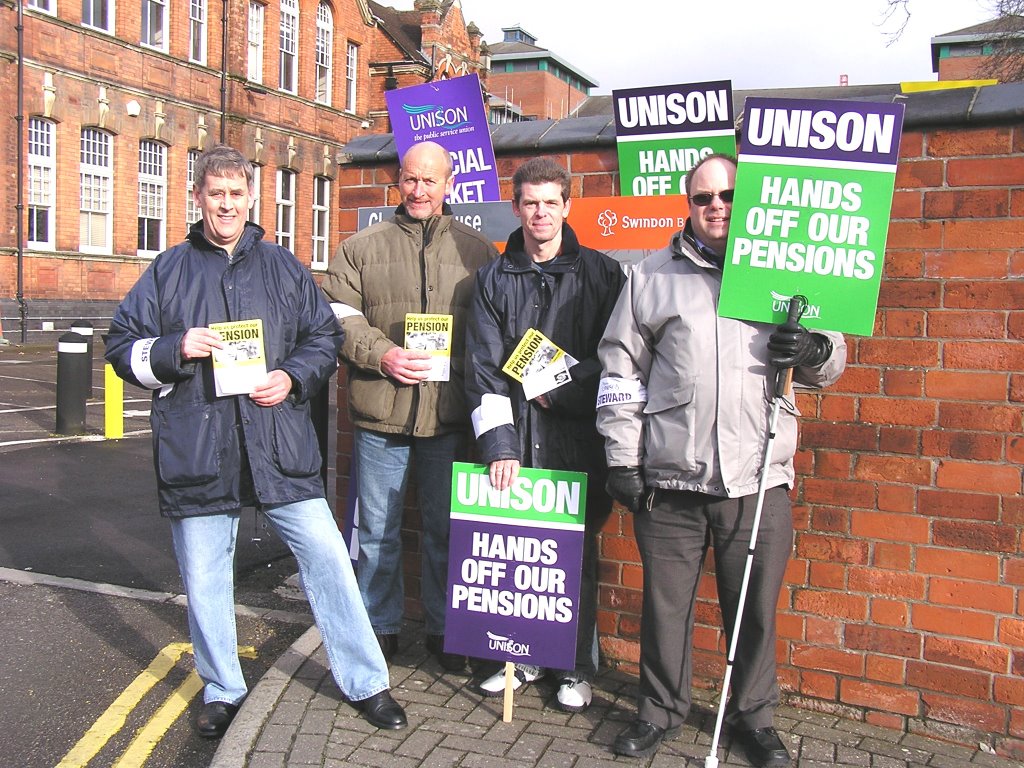

Sunday, February 19, 2006
The Dying Embers…the last days of the smoke filled room?
Ok, I know it’s late in the day, but it’s never too late to come out of the closet. I have to own up to having been a member of an oppressed majority for many years: non-smokers in the labour movement.
Yes, there are considerate smokers, I know. My partner’s daughter accepts that when she visits us she has to go outside to smoke. She doesn’t have a problem with this, and being considerate, she would not dream of forcing anybody to breathe in her smoke.
Oh, but the labour movement. Why has it been full for so many years with people who, whilst fighting for the rights of people at work, could not give a damn about the rights of other people when it came to smoking? You must have met the character, the trade union activist who passionately believes that his ‘democratic right’ to smoke is an absolute. And your right not to breathe it in? It’s not even on his radar. It’s a question of his ‘freedom’.
For many years, be it in the pub or labour movement meetings (often the meetings were in pubs), thousands of us used to troop in and put up with smoke filled rooms. Of course the culture of the labour movement has advanced since then. There will probably be no smoking in your conference now, though many venues took the decision by banning smoking. But the cultural advance did not include social events, of course. The smokers make up for lost time.
Many years ago I had an NUR official, a good bloke, in most respects, who was more or less a chain smoker. Nothing would stop him smoking in union meetings. You could even vote to make them non-smoking, but he would ignore it. One occasion, we had a committee meeting in a small room, and he never stopped. He managed to put me off work for two weeks.
If you don’t like cigarette smoke, or if you have a respiratory problem, such as asthma, for many years it was always difficult to go to labour movement meetings. When I developed a hyper-sensitivity to cigarette smoke, I had to bow out of events because they reduced me to a wheezing wreck. If you tentatively asked for – not demanded – no smoking in a meeting you were made to feel like a freak, an anti-smoking fanatic. Sometimes it was given grudgingly. One regional organisation I used to attend had no smoking in the meeting and then as soon as we reached the break they lit up in the same room, defeating the purpose of having no smoking in the meeting.
It never occurred to the militant ‘smoking rights’ fraternity that people might be discouraged from exercising their democratic right to participate in their union by their reluctance or inability to sit in smoking meetings.
It was pretty much the same in life in general. Smoking was so ubiquitous that not only could you not go to a pub if you had a problem with cigarette smoke. It was difficult to find a restaurant where you could avoid somebody lighting up just as you were about to tuck into your meal.
Where smoking has been banned, in cinemas or on the London Underground, it was the result of accidents in which people were killed as a result of fires caused by cigarettes.
Now we have the furore over the Parliamentary vote introducing a smoking ban in public places. I know smokers who are not troubled by the vote. Some of them, addicted as they are, see it as an encouragement to give up smoking. But the spectacle of left wing activists, being outraged by this apparent attack on ‘civil liberties’…it, pun intended, takes your breath away.
A friend of mine tells me that I am imposing my ‘life-style choices’ on other people! The reality is the opposite. Smokers have imposed their ‘life-style choices’ on me and many others for years. We have been forced to breathe in smoke and go home reeking of the smell for years.
I have even heard left wingers quoting scientific investigation funded by the tobacco companies to prove that ‘passive smoking’ is no great threat! But even if you believe that passive smoking will not kill somebody, what is incontestable is that it will do your health no good.
The history of the tobacco companies is well known. They resisted all evidence that smoking harmed smokers. They rigged the evidence, they carried out an ideological war against all the evidence showing the destructive impact of smoking. They fill their product with carcinogenic substances. They have made a fortune at the expense of making people ill, the bill being picked up by our health service.
Having said that, if somebody choses to smoke, that is their choice. If people want to fill the coffers of the tobacco companies by buying their product that is their choice. I think they are stupid doing something which is so detrimental to their health, but I have no objection to them doing so, provided I do not have to breathe in their smoke.
I can’t help but ruefully remember the picture a room full of health and safety reps, desperately lighting up in the break of an RMT Health & Safety conference, in any area without doors, meaning the smoke drifted through to the main hall.
What about the health and safety of staff in service industries, like pubs, clubs, and restaurants. Ah, says the defender of the ‘democratic right’ of the smoker to force other people to breathe in their smoke, if they don’t like it they shouldn’t work in such a job. No doubt Norman Tebbitt would tell them to ‘get on their bikes’. But not everybody can get the job that they want. So the trade union struggle for health and safety in the workplace is abandoned at the pub or restaurant door? Both the TGWU and the GMB, unions with members who work in smoking environments have supported the ban. There has been no revolt amongst their members.
I have also read that the vote in Parliament is the result of the authoritarian nature of New Labour. This is not true. Remember the Bernie Eccleston affair? The government prevaricated over its commitment to introduce a ban of cigarette advertising for many years. Moreover, in the face of opposition it proposed the ‘compromise’ solution. It only abandoned it, giving a free vote, when it realised that it would lose the vote in Parliament.
But could we not have smoking pubs and non-smoking pubs? The problem with this ‘solution’, of course, is that in the absence of a ban most owners would be frightened to lose their custom if they became a non-smoking establishment. I have even heard a publican say this.
I am not demanding that smokers give up smoking. It’s their life. But for years the law has allowed them to take away the civil liberties, and restricted the lives of those who do not want to breathe in cigarette smoke, or even worse are made ill by it.
Ok, I know it’s late in the day, but it’s never too late to come out of the closet. I have to own up to having been a member of an oppressed majority for many years: non-smokers in the labour movement.
Yes, there are considerate smokers, I know. My partner’s daughter accepts that when she visits us she has to go outside to smoke. She doesn’t have a problem with this, and being considerate, she would not dream of forcing anybody to breathe in her smoke.
Oh, but the labour movement. Why has it been full for so many years with people who, whilst fighting for the rights of people at work, could not give a damn about the rights of other people when it came to smoking? You must have met the character, the trade union activist who passionately believes that his ‘democratic right’ to smoke is an absolute. And your right not to breathe it in? It’s not even on his radar. It’s a question of his ‘freedom’.
For many years, be it in the pub or labour movement meetings (often the meetings were in pubs), thousands of us used to troop in and put up with smoke filled rooms. Of course the culture of the labour movement has advanced since then. There will probably be no smoking in your conference now, though many venues took the decision by banning smoking. But the cultural advance did not include social events, of course. The smokers make up for lost time.
Many years ago I had an NUR official, a good bloke, in most respects, who was more or less a chain smoker. Nothing would stop him smoking in union meetings. You could even vote to make them non-smoking, but he would ignore it. One occasion, we had a committee meeting in a small room, and he never stopped. He managed to put me off work for two weeks.
If you don’t like cigarette smoke, or if you have a respiratory problem, such as asthma, for many years it was always difficult to go to labour movement meetings. When I developed a hyper-sensitivity to cigarette smoke, I had to bow out of events because they reduced me to a wheezing wreck. If you tentatively asked for – not demanded – no smoking in a meeting you were made to feel like a freak, an anti-smoking fanatic. Sometimes it was given grudgingly. One regional organisation I used to attend had no smoking in the meeting and then as soon as we reached the break they lit up in the same room, defeating the purpose of having no smoking in the meeting.
It never occurred to the militant ‘smoking rights’ fraternity that people might be discouraged from exercising their democratic right to participate in their union by their reluctance or inability to sit in smoking meetings.
It was pretty much the same in life in general. Smoking was so ubiquitous that not only could you not go to a pub if you had a problem with cigarette smoke. It was difficult to find a restaurant where you could avoid somebody lighting up just as you were about to tuck into your meal.
Where smoking has been banned, in cinemas or on the London Underground, it was the result of accidents in which people were killed as a result of fires caused by cigarettes.
Now we have the furore over the Parliamentary vote introducing a smoking ban in public places. I know smokers who are not troubled by the vote. Some of them, addicted as they are, see it as an encouragement to give up smoking. But the spectacle of left wing activists, being outraged by this apparent attack on ‘civil liberties’…it, pun intended, takes your breath away.
A friend of mine tells me that I am imposing my ‘life-style choices’ on other people! The reality is the opposite. Smokers have imposed their ‘life-style choices’ on me and many others for years. We have been forced to breathe in smoke and go home reeking of the smell for years.
I have even heard left wingers quoting scientific investigation funded by the tobacco companies to prove that ‘passive smoking’ is no great threat! But even if you believe that passive smoking will not kill somebody, what is incontestable is that it will do your health no good.
The history of the tobacco companies is well known. They resisted all evidence that smoking harmed smokers. They rigged the evidence, they carried out an ideological war against all the evidence showing the destructive impact of smoking. They fill their product with carcinogenic substances. They have made a fortune at the expense of making people ill, the bill being picked up by our health service.
Having said that, if somebody choses to smoke, that is their choice. If people want to fill the coffers of the tobacco companies by buying their product that is their choice. I think they are stupid doing something which is so detrimental to their health, but I have no objection to them doing so, provided I do not have to breathe in their smoke.
I can’t help but ruefully remember the picture a room full of health and safety reps, desperately lighting up in the break of an RMT Health & Safety conference, in any area without doors, meaning the smoke drifted through to the main hall.
What about the health and safety of staff in service industries, like pubs, clubs, and restaurants. Ah, says the defender of the ‘democratic right’ of the smoker to force other people to breathe in their smoke, if they don’t like it they shouldn’t work in such a job. No doubt Norman Tebbitt would tell them to ‘get on their bikes’. But not everybody can get the job that they want. So the trade union struggle for health and safety in the workplace is abandoned at the pub or restaurant door? Both the TGWU and the GMB, unions with members who work in smoking environments have supported the ban. There has been no revolt amongst their members.
I have also read that the vote in Parliament is the result of the authoritarian nature of New Labour. This is not true. Remember the Bernie Eccleston affair? The government prevaricated over its commitment to introduce a ban of cigarette advertising for many years. Moreover, in the face of opposition it proposed the ‘compromise’ solution. It only abandoned it, giving a free vote, when it realised that it would lose the vote in Parliament.
But could we not have smoking pubs and non-smoking pubs? The problem with this ‘solution’, of course, is that in the absence of a ban most owners would be frightened to lose their custom if they became a non-smoking establishment. I have even heard a publican say this.
I am not demanding that smokers give up smoking. It’s their life. But for years the law has allowed them to take away the civil liberties, and restricted the lives of those who do not want to breathe in cigarette smoke, or even worse are made ill by it.
Monday, February 13, 2006
“Home owning democracy”: What’s in a phrase?
A delegation from Swindon trades unions participated in the Parliamentary lobby on February 8th, in support of direct investment in Council Housing. One of the MP's, Anne Snelgrove told us we live in a "home owning democracy". What's in a phrase?
South Swindon’s new Blairite MP Anne Snelgrove told a trade union delegation, participating in the Parliamentary lobby on February 8th, that we live in a “home owning democracy”. She was explaining why she was opposed to Councils building new Council housing. “Home owning democracy”; the phrase rang a bell. Didn’t Thatcher use it? Yes, in her assault on Council Housing she boasted of building a ‘home owning democracy’. This was why she introduced the ‘right to buy’ through which Council housing was given away to tenants with a massive discount. It was a conscious policy designed to destroy Council housing estates as bastions of electoral support for Labour. How could people with ‘capital’ vote Labour?
That a Blairite MP like Snelgrove can utter the phrase without the least embarrassment reflects the degree to which New Labour is rooted in the Thatcher legacy. Historically, democracy was something which working people had to fight for in the teeth of resistance from the British rulers. Even with the passing of the ‘Great Reform’ Act of 1832 (1) only around one in five males had the vote, women none at all. The franchise conceded was based on the value of the property you owned or lived in. Universal suffrage strictly speaking was not conceded until 1928, and even then, the phenomenon of double voting was not done away with until after the Second World War. So home ownership was an important part of the pseudo-democracy which Britain’s rulers conceded piecemeal in order to hang onto their wealth and power.
No doubt Snelgrove does not mean by “home owning democracy” that those who do not own a home should not have the vote. Rather, it reflects the Thatcherite prejudices about ‘standing on your own two feet’, ‘welfare dependency’ etc, which Blair and his clones swallowed whole. We are all ‘Thatcherites’ now declared Peter Mandelson.
New Labour is the “Party of aspiration” we are told. One New Labour councillor in Swindon some years back spoke with disdain about the fact that there were some families who lived on the Parks council estate for three generations! Can you imagine somebody preferring to live in a Council house rather than owning their own home? Obviously they lacked ambition and ‘aspiration’.
But the labour movement historically had collective aspirations. It wanted to improve the lot of the working class as a whole. New Labour has been created by people for whom personal advancement is their driving aspiration. Obviously anybody who lives in council accommodation cannot possibly be a “success” or they would be able to afford to buy their own home.
One of the tenets of New Labour under Blair was that opposing the right to buy had been a big political mistake, from an electoral point of view. But the results of ‘right to buy’ were disastrous. In conjunction with what was effectively a ban on new Council House building (financially penalising Councils for building new stock), it created a massive shortage of Council Housing (2) and helped to drive up prices in the private housing market. The shortage forced people who might have been on a Council House waiting list, to buy their own house (often beyond their means).
Many people bought their home because it was an offer which was too good to be true. The mortgage was often lower than the rent. However, what some did not think about was the cost of maintenance. On the estate which I live on you can see decaying housing which people snapped up but which they did not have the means to modernise, next to Council Housing which has had double glazing and central heating fitted.
After the initial enthusiasm of purchase there was a high occurrence of repossession as new owners found themselves in financial difficulties, especially in the period of high unemployment.
Snelgrove might have no problem uttering the mantra of Thatcher. However, it is worth pausing to consider the consequences of her policy (for the younger generations she is only a figure out of the history books), many elements of which have been left intact by New Labour. The commentary of Ian Gilmour, an opponent of hers within the Tory Party, throws an interesting light on her policy.
The ‘right to buy’ was taken up, during Thatcher’s reign by 1.5 million families. Although in favour of selling Council homes to tenants, Gilmour complained that the government was “more concerned with diminishing the role of local authorities than with the provision of affordable homes”.
“In consequence, so far from doing much to relieve the housing shortage, which it had inherited, the government by its policies, in some places drastically exacerbated it.”
Nicholas Ridley, the Environment Secretary from 1986-9 was “determined to weaken the almost incestuous relationship between some Councils and their tenants”. A 1988 Housing Act encouraged the transfer of tenanted council estates to other landlords through ‘Housing Action Trusts’. The government rigged the voting system by counting those who did not vote as voting in favour of transfer! As Gilmour comments, despite the rigged system, the great majority of tenants decided to ‘continue to live in incest’. At the time many Labour Councils and Councillors helped to lead the campaign against what was known as “pick a landlord”.
When Anne Snelgrove says that Housing Action Trusts would be better building housing she forgets this Thatcherite attempt to destroy Council Housing.
Gilmour continues:
“Homelessness is far from new, but the sale of Council houses, backed by financial incentives (Thatcher’s favourite Council, Wandsworth, offered free holidays to tenants who bought their homes), required a high rate of council house building…or some alternative provision if it was not to lead to increased homelessness. Instead, local authorities were forbidden to spend more than a quarter of the revenue generated from council house sales on new homes and renovations. In so far as the government recognised the resulting problem of homelessness, it left it to be solved by the market. Thus the placing of homeless families in temporary accommodation by local authorities owed less to bad housing management, as the Thatcherites claimed, than to the financial restrictions that they themselves imposed onto the amount of money that could be spent on repairs to make empty properties inhabitable.”
Because local authorities were prevented by the government from providing new homes, they had (in the words of the chair of the then Conservative controlled London Borough Association) to “spend a fortune” on temporary accommodation for the homeless. “This waste of resources”, he said “completely frustrates our objective of achieving value for money and only adds to the appalling amount of human misery involved.”
Ironically, for all the talk of “welfare dependency” what the Thatcher government did was to cut welfare to the poor and increase it to the rich. In 1979 subsidies to owner occupiers and council tenants were roughly equal. By the end of the 1980s the subsidy to council tenants had fallen to around £500 million, while the public handout to owner occupiers in the form of mortgage tax relief had climbed to £5.5 billion.
As a result of the policies of the Thatcher government, in the words of Gilmour, the council house became “more and more the preserve of the very poor”. Before the ‘right to buy’ Council estates comprised a wide cross section of working class people. One of the consequences of the social catastrophe for which the Thatcher government was responsible, was the growth of mass unemployment. Thatcher’s housing policy created conditions where the best stock was bought by those who could afford it. Whilst some people refused to buy out of principled opposition to the policy, probably the majority of those who could afford to buy, did so, thinking as individuals and ignoring the social consequences of their self-interest.
Progressively, Council housing comprised the poorest sections of the community. The absence of new building meant that very few people had a chance of getting accommodation under the points system by which priority was decided. Single parents became a large proportion of those in Council accommodation. The fact that only the most impoverished sections of the community tend to live in Council accommodation is reflected in the statistics. Up to two thirds of tenants receive benefit of one sort or another. Today many people who might have put their names on the list do not bother because the wait is so long.
It is ironic that a ‘one nation’ Tory like Gilmour could see the consequences of Thatcher’s policy, but in contrast the ideological creators of New Labour, in the words of Mandelson wanted to “move forward from where Margaret Thatcher left off”, leaving in place much of her policy.
Like all Blairites, Snelgrove appears to be prejudiced against social provision which was part and parcel of post-Second World War social democracy. She is opposed to Councils being given the right to build new stock. She believes in the 'purchaser/provider' split. She is convinced that private business is ‘more efficient’. Much better that the private sector provide housing, in her view.
Of course, Councils don’t have the resources to build Council Housing themselves. The one I live on was built by John Laing. But Council housing was considered necessary in order to tackle the problem of much of the population living in overcrowded and poor conditions. The history of private landlords in Britain is well known. “Take the money and do as little as possible to maintain the state of accommodation,” was the principle on which many of them operated. Council accommodation greatly improved the quality of life for millions of working class people.
The Blair government’s policy on housing was rooted in Thatcher’s programme. They set out to remove Council Housing from the scene. They set themselves the target of transferring 200,000 houses a year. For Gordon Brown, getting rid of Council housing was a function of managing ‘his’ national balance sheet. It would make the book look better, removing historical housing debt from public accounts.
However, council tenants have a different point of view. Despite all the blackmail and all the tricks, many of them have resisted the transfer of their housing. It is not because they are in love with their councils. Indeed dealing with bureaucracy is one of the downsides of being a tenant. They have opposed privatisation because being a council tenant gives them an affordable home and security of tenure. And stories of life before the big building programmes are passed down from generation to generation. The Racnmanite landlord was a common figure only 40 years ago (3) .
After the delegation from Swindon had met our two MPs, we walked over to the Defend Council Housing rally in Westminster Hall. Gerald Kaufmann, the former Labour Minister, was speaking on the platform. The contrast with New Labour MPs could not have been more graphic. Kaufmann was on the right of the old Labour Party, a member of the last pre-Blair Labour government. Yet here he was not only demanding that Councils have the right to direct investment in their existing stock, but spoke of the need to build new council housing. He reminded us that Tory and Labour governments used to compete about how many Council Houses they had built.
He confessed that when last in the government he had introduced legislation that had given Housing Associations the right to build public housing in conjunction with councils. But it was only conceived as a small niche. Never, he said, did he imagine that Housing Associations would end up as the sole provider of public housing.
Housing Associations are considered providers of ‘social housing’. But, said Kauffman, a lot of his constituency work involved dealing with problems which tenants had with Housing Associations, which are unaccountable organisations. The only ‘public housing’ now built is the result of collaboration between Housing Associations and Local authorities, often accommodation for elderly people. But the amount being built is miniscule.
Anne Snelgrove did express the view that there is a need for more ‘affordable housing’. But the reality is that the housing market will not deliver it. The government is prepared to offer mortgage relief to private owners. It has been prepared to write off historical housing debt for councils whose tenants vote to transfer to another owner. It offers funds for the lunacy of people buying half a mortgage, giving them the privilege of paying mortgage and rent at the same time!
Yet it still refuses to give Councils the right to build new Council Housing. It appears to be politically and ideologically opposed to such a thing. When Gordon Brown recently spoke about his belief in “21st century individualism” he more or less said that people will have to buy their own homes. Clearly he does not believe Councils should build any.
However, the housing crisis will not be addressed by the market or by government help for people to buy. Personal debt is at historically unprecedented levels. The crisis can only realistically be addressed by a new programme of Council House building. The government’s housing policy is in a state of disarray. Their attempt to eradicate Council Housing has been defeated by the resistance of tenants and trades unions. The campaign for the right of Councils to start building Council housing needs to be stepped up.
Notes
A delegation from Swindon trades unions participated in the Parliamentary lobby on February 8th, in support of direct investment in Council Housing. One of the MP's, Anne Snelgrove told us we live in a "home owning democracy". What's in a phrase?
South Swindon’s new Blairite MP Anne Snelgrove told a trade union delegation, participating in the Parliamentary lobby on February 8th, that we live in a “home owning democracy”. She was explaining why she was opposed to Councils building new Council housing. “Home owning democracy”; the phrase rang a bell. Didn’t Thatcher use it? Yes, in her assault on Council Housing she boasted of building a ‘home owning democracy’. This was why she introduced the ‘right to buy’ through which Council housing was given away to tenants with a massive discount. It was a conscious policy designed to destroy Council housing estates as bastions of electoral support for Labour. How could people with ‘capital’ vote Labour?
That a Blairite MP like Snelgrove can utter the phrase without the least embarrassment reflects the degree to which New Labour is rooted in the Thatcher legacy. Historically, democracy was something which working people had to fight for in the teeth of resistance from the British rulers. Even with the passing of the ‘Great Reform’ Act of 1832 (1) only around one in five males had the vote, women none at all. The franchise conceded was based on the value of the property you owned or lived in. Universal suffrage strictly speaking was not conceded until 1928, and even then, the phenomenon of double voting was not done away with until after the Second World War. So home ownership was an important part of the pseudo-democracy which Britain’s rulers conceded piecemeal in order to hang onto their wealth and power.
No doubt Snelgrove does not mean by “home owning democracy” that those who do not own a home should not have the vote. Rather, it reflects the Thatcherite prejudices about ‘standing on your own two feet’, ‘welfare dependency’ etc, which Blair and his clones swallowed whole. We are all ‘Thatcherites’ now declared Peter Mandelson.
New Labour is the “Party of aspiration” we are told. One New Labour councillor in Swindon some years back spoke with disdain about the fact that there were some families who lived on the Parks council estate for three generations! Can you imagine somebody preferring to live in a Council house rather than owning their own home? Obviously they lacked ambition and ‘aspiration’.
But the labour movement historically had collective aspirations. It wanted to improve the lot of the working class as a whole. New Labour has been created by people for whom personal advancement is their driving aspiration. Obviously anybody who lives in council accommodation cannot possibly be a “success” or they would be able to afford to buy their own home.
One of the tenets of New Labour under Blair was that opposing the right to buy had been a big political mistake, from an electoral point of view. But the results of ‘right to buy’ were disastrous. In conjunction with what was effectively a ban on new Council House building (financially penalising Councils for building new stock), it created a massive shortage of Council Housing (2) and helped to drive up prices in the private housing market. The shortage forced people who might have been on a Council House waiting list, to buy their own house (often beyond their means).
Many people bought their home because it was an offer which was too good to be true. The mortgage was often lower than the rent. However, what some did not think about was the cost of maintenance. On the estate which I live on you can see decaying housing which people snapped up but which they did not have the means to modernise, next to Council Housing which has had double glazing and central heating fitted.
After the initial enthusiasm of purchase there was a high occurrence of repossession as new owners found themselves in financial difficulties, especially in the period of high unemployment.
Snelgrove might have no problem uttering the mantra of Thatcher. However, it is worth pausing to consider the consequences of her policy (for the younger generations she is only a figure out of the history books), many elements of which have been left intact by New Labour. The commentary of Ian Gilmour, an opponent of hers within the Tory Party, throws an interesting light on her policy.
The ‘right to buy’ was taken up, during Thatcher’s reign by 1.5 million families. Although in favour of selling Council homes to tenants, Gilmour complained that the government was “more concerned with diminishing the role of local authorities than with the provision of affordable homes”.
“In consequence, so far from doing much to relieve the housing shortage, which it had inherited, the government by its policies, in some places drastically exacerbated it.”
Nicholas Ridley, the Environment Secretary from 1986-9 was “determined to weaken the almost incestuous relationship between some Councils and their tenants”. A 1988 Housing Act encouraged the transfer of tenanted council estates to other landlords through ‘Housing Action Trusts’. The government rigged the voting system by counting those who did not vote as voting in favour of transfer! As Gilmour comments, despite the rigged system, the great majority of tenants decided to ‘continue to live in incest’. At the time many Labour Councils and Councillors helped to lead the campaign against what was known as “pick a landlord”.
When Anne Snelgrove says that Housing Action Trusts would be better building housing she forgets this Thatcherite attempt to destroy Council Housing.
Gilmour continues:
“Homelessness is far from new, but the sale of Council houses, backed by financial incentives (Thatcher’s favourite Council, Wandsworth, offered free holidays to tenants who bought their homes), required a high rate of council house building…or some alternative provision if it was not to lead to increased homelessness. Instead, local authorities were forbidden to spend more than a quarter of the revenue generated from council house sales on new homes and renovations. In so far as the government recognised the resulting problem of homelessness, it left it to be solved by the market. Thus the placing of homeless families in temporary accommodation by local authorities owed less to bad housing management, as the Thatcherites claimed, than to the financial restrictions that they themselves imposed onto the amount of money that could be spent on repairs to make empty properties inhabitable.”
Because local authorities were prevented by the government from providing new homes, they had (in the words of the chair of the then Conservative controlled London Borough Association) to “spend a fortune” on temporary accommodation for the homeless. “This waste of resources”, he said “completely frustrates our objective of achieving value for money and only adds to the appalling amount of human misery involved.”
Ironically, for all the talk of “welfare dependency” what the Thatcher government did was to cut welfare to the poor and increase it to the rich. In 1979 subsidies to owner occupiers and council tenants were roughly equal. By the end of the 1980s the subsidy to council tenants had fallen to around £500 million, while the public handout to owner occupiers in the form of mortgage tax relief had climbed to £5.5 billion.
As a result of the policies of the Thatcher government, in the words of Gilmour, the council house became “more and more the preserve of the very poor”. Before the ‘right to buy’ Council estates comprised a wide cross section of working class people. One of the consequences of the social catastrophe for which the Thatcher government was responsible, was the growth of mass unemployment. Thatcher’s housing policy created conditions where the best stock was bought by those who could afford it. Whilst some people refused to buy out of principled opposition to the policy, probably the majority of those who could afford to buy, did so, thinking as individuals and ignoring the social consequences of their self-interest.
Progressively, Council housing comprised the poorest sections of the community. The absence of new building meant that very few people had a chance of getting accommodation under the points system by which priority was decided. Single parents became a large proportion of those in Council accommodation. The fact that only the most impoverished sections of the community tend to live in Council accommodation is reflected in the statistics. Up to two thirds of tenants receive benefit of one sort or another. Today many people who might have put their names on the list do not bother because the wait is so long.
It is ironic that a ‘one nation’ Tory like Gilmour could see the consequences of Thatcher’s policy, but in contrast the ideological creators of New Labour, in the words of Mandelson wanted to “move forward from where Margaret Thatcher left off”, leaving in place much of her policy.
Like all Blairites, Snelgrove appears to be prejudiced against social provision which was part and parcel of post-Second World War social democracy. She is opposed to Councils being given the right to build new stock. She believes in the 'purchaser/provider' split. She is convinced that private business is ‘more efficient’. Much better that the private sector provide housing, in her view.
Of course, Councils don’t have the resources to build Council Housing themselves. The one I live on was built by John Laing. But Council housing was considered necessary in order to tackle the problem of much of the population living in overcrowded and poor conditions. The history of private landlords in Britain is well known. “Take the money and do as little as possible to maintain the state of accommodation,” was the principle on which many of them operated. Council accommodation greatly improved the quality of life for millions of working class people.
The Blair government’s policy on housing was rooted in Thatcher’s programme. They set out to remove Council Housing from the scene. They set themselves the target of transferring 200,000 houses a year. For Gordon Brown, getting rid of Council housing was a function of managing ‘his’ national balance sheet. It would make the book look better, removing historical housing debt from public accounts.
However, council tenants have a different point of view. Despite all the blackmail and all the tricks, many of them have resisted the transfer of their housing. It is not because they are in love with their councils. Indeed dealing with bureaucracy is one of the downsides of being a tenant. They have opposed privatisation because being a council tenant gives them an affordable home and security of tenure. And stories of life before the big building programmes are passed down from generation to generation. The Racnmanite landlord was a common figure only 40 years ago (3) .
After the delegation from Swindon had met our two MPs, we walked over to the Defend Council Housing rally in Westminster Hall. Gerald Kaufmann, the former Labour Minister, was speaking on the platform. The contrast with New Labour MPs could not have been more graphic. Kaufmann was on the right of the old Labour Party, a member of the last pre-Blair Labour government. Yet here he was not only demanding that Councils have the right to direct investment in their existing stock, but spoke of the need to build new council housing. He reminded us that Tory and Labour governments used to compete about how many Council Houses they had built.
He confessed that when last in the government he had introduced legislation that had given Housing Associations the right to build public housing in conjunction with councils. But it was only conceived as a small niche. Never, he said, did he imagine that Housing Associations would end up as the sole provider of public housing.
Housing Associations are considered providers of ‘social housing’. But, said Kauffman, a lot of his constituency work involved dealing with problems which tenants had with Housing Associations, which are unaccountable organisations. The only ‘public housing’ now built is the result of collaboration between Housing Associations and Local authorities, often accommodation for elderly people. But the amount being built is miniscule.
Anne Snelgrove did express the view that there is a need for more ‘affordable housing’. But the reality is that the housing market will not deliver it. The government is prepared to offer mortgage relief to private owners. It has been prepared to write off historical housing debt for councils whose tenants vote to transfer to another owner. It offers funds for the lunacy of people buying half a mortgage, giving them the privilege of paying mortgage and rent at the same time!
Yet it still refuses to give Councils the right to build new Council Housing. It appears to be politically and ideologically opposed to such a thing. When Gordon Brown recently spoke about his belief in “21st century individualism” he more or less said that people will have to buy their own homes. Clearly he does not believe Councils should build any.
However, the housing crisis will not be addressed by the market or by government help for people to buy. Personal debt is at historically unprecedented levels. The crisis can only realistically be addressed by a new programme of Council House building. The government’s housing policy is in a state of disarray. Their attempt to eradicate Council Housing has been defeated by the resistance of tenants and trades unions. The campaign for the right of Councils to start building Council housing needs to be stepped up.
Notes
(1) The Prime Minister Grey explained: “The principle of my reform is to prevent the necessity of revolution…there is no one more dedicated against annual parliaments, universal suffrage, and the (secret) ballot than I am.”
(2) Ironically by relying on ‘market forces’ the concentration of wealth and economic activity has created a situation where in areas like Swindon there has been a massive increase in the Council House waiting list, whilst in other parts of the country, which have suffered an exodus of jobs and population, Council accommodation lies empty, with insufficient ‘demand’ for it.
(3) Rachman was a notorious slum landlord in London.
Subscribe to:
Posts (Atom)